
Egg anatomy for kids, with a free printable diagram
The eleven parts of a chicken egg in plain words, each one checked against USDA, with a free printable diagram, a blank page to label, and a 20-minute kitchen look and find for ages 4 to 14.
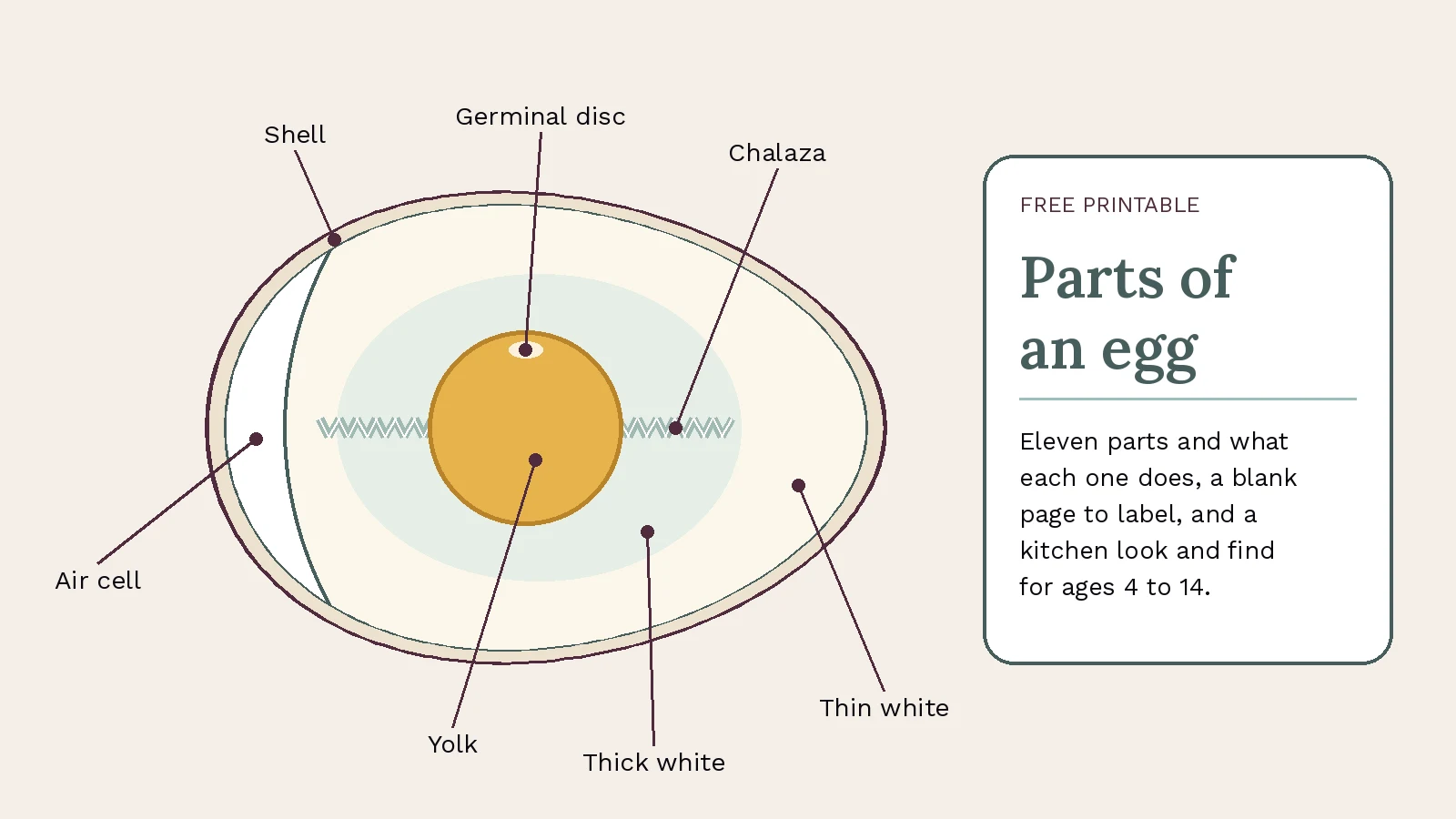
Crack an egg into a clear bowl and a child will see a yolk and some white. Look closer and there is a lot more in there. There is a pocket of air, two thin skins, twisted cords that hold the yolk in place, and a tiny spot on the yolk itself.
Most egg diagrams online are a word bank and a picture. They don't say what each part does, and almost none of them say where their facts came from. This one sticks to the USDA. The parts and their jobs come from the USDA's Egg-Grading Manual and from two USDA Food Safety and Inspection Service (FSIS) guides.
At the end there is a free printable with a labeled diagram, a blank page to label, and a kitchen look and find at three levels for ages 4 to 14.
Download the free egg diagram (PDF, 3 pages)
The egg by the numbers
The Egg-Grading Manual says an average chicken egg "weighs about 57 grams or 2 ounces." It breaks that weight into three main parts.
| Part | Share of the whole egg | What it is mostly made of |
|---|---|---|
| Shell | about 11% | calcium carbonate, about 94% of the dry shell |
| White (albumen) | about 58% | about 88% water and 11% protein |
| Yolk | about 31% | about 48% water, 32.5% fat and 17.5% protein |
So in a 57 gram egg, the shell is about 6 grams, the white about 33 grams and the yolk about 18 grams. Older kids can check this with a kitchen scale (it's on the printable).
The outside of the egg
1. Cuticle
The cuticle is a thin coating on the outside of the shell. FSIS says that "by blocking the pores, the cuticle helps to preserve freshness and prevent microbial contamination of the contents." You may hear it called the bloom. The Egg-Grading Manual says it is "sometimes erroneously referred to as 'bloom.'"
The Egg-Grading Manual says washing removes most of the outer cuticle. FSIS says "it's not necessary or recommended for consumers to wash eggs," because the wash water can be "sucked" into the egg through the pores in the shell.
2. Shell
The shell is hard and made almost entirely of calcium carbonate. FSIS says it has "approximately 17,000 tiny pores" and that "air and moisture can pass through its pores." A shell looks solid, but it breathes.
3 and 4. Outer and inner shell membranes
Just inside the shell are two thin, clear skins. FSIS calls them "two transparent protein membranes" that "provide efficient defense against bacterial invasion." They are made partly of keratin, the same kind of protein found in hair.
5. Air cell
A brand new egg has no air cell at all. FSIS explains that "the egg, as laid at 105 degrees F, normally has no air cell. As the egg cools, an air cell forms usually in the large end of the egg and develops between the two shell membranes." After that, the Egg-Grading Manual says the air cell keeps growing as water evaporates from the egg, so an older egg has a bigger one.
This is a good one for children to find. After cracking, look inside the big end of the empty shell for a little hollow where the inner membrane pulls away.
The inside of the egg
6 and 7. Thin white and thick white
The white is called the albumen. FSIS describes "four alternating layers of thick and thin albumen" holding about 40 different proteins. In a bowl, the thick white sits up around the yolk and the thin white runs out to the edges.
The white also tells you how fresh an egg is. FSIS says "a cloudy white (albumen) is a sign the egg is very fresh. A clear egg white is an indication the egg is aging."
8. Chalazae
The chalazae (FSIS spells out the sound as kah-LAY-zuh) are the white, twisted cords next to the yolk. FSIS calls them "the twisted cord-like strands of egg white that anchor the yolk in the center of the white." They twist as the yolk turns while the white is being formed inside the hen. One cord is a chalaza.
They are part of the white, not a flaw. FSIS says "the more prominent they are, the fresher the egg."
9. Vitelline membrane
This is the clear casing around the yolk. FSIS says "its strength protects the yolk from breaking," and that it "tends to become more fragile as the egg ages." So the yolk of an older egg is easier to break.
10. Yolk
The yolk is the round, yellow center. FSIS says it "contains less water and more fat than the white." Point back to the table above and children can see the same thing in numbers.
11. Germinal disc
The germinal disc is a small spot on the yolk. The Egg-Grading Manual says "the germ stays at the surface of the yolk." The manual explains that sperm, if present, "fertilize the germ and set up embryonic growth." FSIS notes that "commercially produced eggs are not fertilized," so eggs from the store will not grow chicks.
What about the spots?
Sometimes a child finds a small red spot. FSIS says blood spots "are caused by a rupture of one or more small blood vessels at the time of ovulation" and that this "does not indicate the egg is unsafe." Fewer than 1% of eggs have them, according to FSIS.
The kitchen look and find
This takes about 20 minutes, and every child needs the same few things. One raw egg, a clear bowl or plate, a spoon and the printable.
Ages 4 to 6
Find four parts. The shell, the air cell inside the big end of the shell, the white and the yolk. Then draw the egg in the box on the page.
Ages 7 to 10
Find as many of the eleven as you can, with the labeled diagram open next to the bowl (the cuticle is too thin to see). Peel a bit of membrane from inside the shell, find the chalazae, and spot where the thick white ends and the thin white begins. Is the white cloudy or clear?
Ages 11 to 14
Weigh the egg, crack it, and weigh the shell. Work out what share of the egg the shell was, then compare it with the manual's 11%. If you have two eggs with different dates on the carton, crack both and compare the air cell, the chalazae and the white. Write down what changed.
Egg look and find
Before you crack it
- Hands washed, egg, clear bowl, spoon and the printable ready
- Egg weighed in the shell (ages 11 to 14)
Find it
- Shell
- Shell membranes, peeled from inside the shell
- Air cell inside the large end
- Thick white around the yolk and thin white at the edge
- Chalazae next to the yolk
- Yolk and its clear casing
- Germinal disc on the surface of the yolk
Think about it
- Is the white cloudy (very fresh) or clear (older)?
- How big is the air cell?
- Shell weight divided by egg weight, times 100
Clean up
- Egg cooked until the white and yolk are firm, or refrigerated and cooked within 24 hours
- Bowl, spoon and counter washed with hot, soapy water
- Hands washed with soap and water
From mothersteader.com. Sources are listed with the full guide.
Keep the eggs that are left
FSIS says to store eggs "in the refrigerator set at 40 degree F or below," in their carton and "in the coldest part of the refrigerator, not in the door." If the lesson leaves eggs sitting on the table, FSIS says "refrigerated eggs should not be left out more than 2 hours."
Two weeks of chickens, if they want more
If one egg turns into a dozen questions, the Homestead Unit Study: The Chicken takes it further. It has ten lessons over two weeks at three age levels, with egg anatomy, the 21-day embryo calendar, worksheets and an answer key. Families with a flock can keep chores going all winter with our guide to keeping chicken water open when it freezes. And if you file school work by the year, the finished egg page can go straight into the records described in homeschool records worth keeping every year.
We send one email when a new guide or printable is ready. Sign up below if you'd like the next one.
Sources
- Egg-Grading Manual (Agricultural Handbook Number 75) (USDA Agricultural Marketing Service)
- Biology of Eggs (USDA Food Safety and Inspection Service)
- Shell Eggs from Farm to Table (USDA Food Safety and Inspection Service)
From the shop
Homestead Unit Study: The Chicken
A two-week homeschool unit study from the backyard flock for ages 4 to 14. Ten lessons, three age levels, worksheets, public-domain copywork and an answer key, with every fact cited to university extension or CDC pages. 23 printable pages.
$12 $9
New guides and printables, now and then
One email when something new and useful is ready. No sales every week.