
Homeschool records worth keeping every year
What to keep from every homeschool year, what to keep for good, what changes in seventh grade and high school, and how to store it so one flood or one dead laptop can't take it. With a printable end-of-year records checklist.
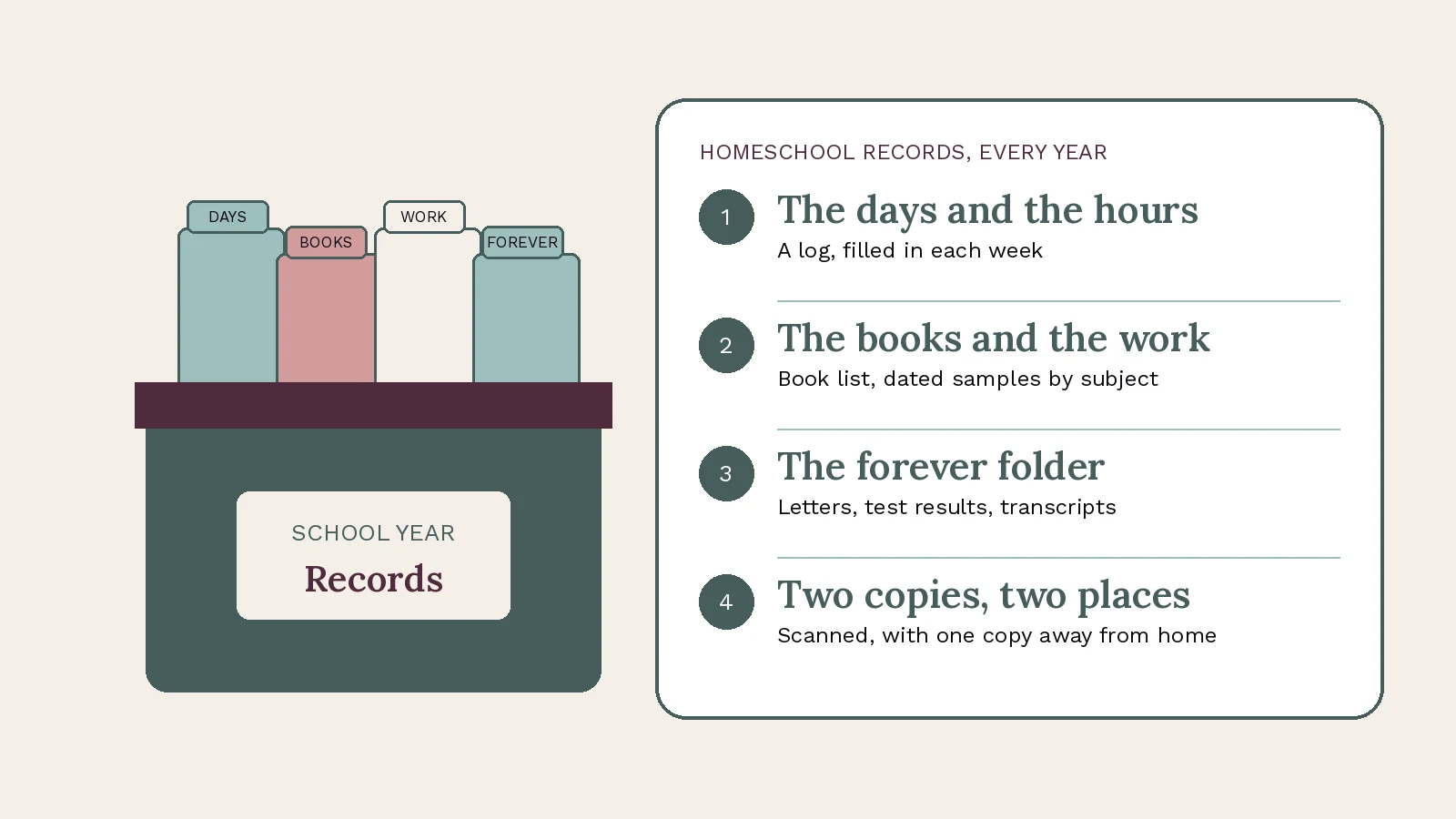
Every homeschool year makes paper. Reading logs, math pages, a lapbook that took a week, the field trip ticket stuck to the fridge. By spring the question is what to keep, what to toss, and where to put the part that matters.
HSLDA, the Home School Legal Defense Association, gives the plain reasons to keep them. Work samples "are very helpful if you ever need to substantiate your child's educational progress for government officials," and grade records may be needed "if you decide to send your child to a traditional school." Later, for a high schooler, HSLDA warns that "poor or missing records can damage a homeschool grad's chances of attending college or vocational school."
This guide is the short version. What goes in the box each year, what stays for good, what changes at seventh grade and again at ninth, and how to store it so it survives. The printable checklist is at the end.
What goes in the box every year
These are the records HSLDA lists in its guide to the types of homeschool records. The last column is our suggestion for when to add to each one. You don't need every row. Keep the ones that fit how you teach.
| Record | What it is | When to add to it |
|---|---|---|
| Attendance or a days log | The dates you held school | Daily or weekly |
| Hours of instruction | Time spent by subject, if you count hours | Daily or weekly |
| Book and curriculum list | Every book read and every program used | As you finish each one |
| Work samples | A few finished pieces from each subject | Start, middle and end of each term |
| Grade records | Grades for each subject | Each term |
| Key to your grading system | How you decide a grade or a pass | Once, then when it changes |
| Test scores | Results of any test your child takes | When results arrive |
| Awards and activities | Certificates, sports, music, Scouts, volunteering | As they happen |
| Correspondence with school officials | Copies of every letter or form, sent and received | Every time |
| Records from earlier schools | Report cards or transcripts from any school attended | Once |
HSLDA's list of other records also includes copies of birth certificates and immunization records or waivers. Those belong in the family file, but it helps to know where they are when a school or program asks.
How long to keep it
Before high school, HSLDA says "most of the records described above can be kept at your discretion." For work samples, it encourages a three-year cycle, "the current year's work, plus samples from the previous two years."
A few things HSLDA would keep forever, whatever the grade. It recommends keeping "all correspondence with school officials" permanently, along with "any test scores or portfolios from state-required end-of-year assessments." If your family never sends a letter or takes a required test, that part of the box stays empty, and that is fine.
Work samples without a mountain of paper
Work samples show what a child could do, in their own hand. They are also the part of the box that grows fastest.
A simple rule keeps it small. For each subject, keep one piece from the start of the term, one from the middle and one from the end, so the growth shows. Date each one and write the subject on the back. Photograph big projects, models and anything three-dimensional, and keep the photo instead of the poster board. Everything else can go home with a grandparent, onto the fridge, or into the recycling with a clear conscience.
Unit studies make this easier, because the finished pages already show a whole topic from start to finish in one place.
From seventh grade on, keep more
The rules of thumb change as high school gets close, because records start to matter for what comes after.
- Seventh and eighth grade. HSLDA says it is "a good idea to hang onto your child's 7th- and 8th-grade work samples for three years each."
- High school work samples. HSLDA says to "keep samples from all four years of high school until your child has graduated."
- The transcript. HSLDA calls a transcript "a concise, accurate one-page record of the academic courses your teen takes during high school," and says "it is best to begin compiling the transcript when your teen is in 9th grade and then add to it each year." Building it a year at a time is much easier than rebuilding four years from memory in the fall of senior year.
- Course descriptions. HSLDA says these "are vital for students applying to selective colleges, qualifying for substantial scholarships, seeking admission to any of the military academies, or qualifying for NCAA eligibility." Write each one the year the course is taught, while the books and projects are still on the shelf.
- Earlier schools and outside courses. If your teen went to a school before homeschooling, HSLDA says to "be sure to request a partial transcript from any public or private high school your teen may have attended." It also says to keep copies of transcripts from community college or other dual-enrollment courses. Ask for the record when the class ends.
For high school, HSLDA recommends keeping these records permanently, in its words "report cards, transcripts, standardized test scores, college entrance test scores, and immunization records." It adds that "many families keep course descriptions as well."
What one college asks a homeschool parent for
It helps to see the other end. Caltech's Secondary School Report for homeschooled applicants asks the parent or homeschool supervisor for the senior year course list, a description of the homeschool program and how it is structured, a GPA with its scale, and narrative comments on the student. It also says "Caltech requires official grades for all coursework, regardless of the setting," asks for official transcripts from any outside provider, and for every course the parent taught, "a formal, education supervisor-created transcript."
That is one college's form, not a rule for every college. But a family that has kept a course list, a grading key, course descriptions and a running transcript can fill in most of it from the box.
Store it so it survives
HSLDA's guide to high school records carries a warning worth keeping at every age. "Whatever you decide, remember to keep copies or backups!" The risks it names are "a computer malfunction, house fire, or other unexpected circumstance."
Here is a setup that covers those risks without much work.
- One box or binder per child per school year. Label the spine with the child's first name and the school year. Paper goes in as you go, not in a heap in June.
- A scan of the parts that matter. At the end of each term, scan or photograph the days log, hours, book list, grades and the work samples you kept. Name each file with the year, the child and the record, so a search finds it in ten years.
- Two copies, in two places. Keep the scans in a cloud folder and on a drive that lives somewhere other than your house, such as with a relative. A fire or a flood should only be able to take one copy.
- The forever folder. Keep the records you will never throw away (correspondence, any required test results, and in high school the transcript, report cards and test scores) in one clearly named folder, separate from the rolling three years.
A weekly habit that keeps it easy
Records get hard when they get saved up. A few minutes at the end of each school week is usually enough. Fill in the days and hours, add any finished books to the list, drop the week's best page into the folder for its subject, and put any letter or form into the box the day it arrives.
If you count hours, a tracker that adds them up for you saves the end-of-year math. The Homeschool of One Hours Tracker turns minutes by subject into hours, school days and progress toward your goal, month by month, in Google Sheets or Excel. The Homeschool of One Planner, made by Alli for families with one student, has attendance and hours record pages built in.
The checklist
Print it and keep it in the front of this year's box.
End-of-year homeschool records checklist
Every year
- Days log or attendance record complete for the year
- Hours by subject totaled, if you count hours
- Book and curriculum list complete
- Work samples kept for each subject, start, middle and end of the term, dated
- Big projects photographed, photos labeled
- Grades written for each subject
- Key to your grading system in the box
- Test results filed, if any test was taken
- Awards, activities, field trips and volunteering listed
- Every letter or form to or from school officials copied and filed
- Anything your state requires, checked against your state's own rules
Storage
- Box or binder labeled with the child's first name and school year
- Key records scanned and named by year, child and record
- Scans saved in two places, one of them away from home
- Forever folder updated
- Before high school, work samples older than three years sorted out
Seventh grade and up
- Seventh and eighth grade work samples kept for three years each
- High school work samples kept until graduation
- Transcript updated with this year's courses, credits and grades
- Course description written for each course taught this year
- Partial transcript requested from any earlier school, and copies kept of transcripts from any outside or dual-enrollment class
- Transcript, report cards and test scores copied into the forever folder
From mothersteader.com. Sources are listed with the full guide.
More for the homeschool year
If the box needs good things to put in it, our Homestead Unit Study: Snow and Weather fits the winter months, and the finished pages make ready-made work samples. More homeschooling guides are on the homeschooling page of the blog.
We send one email when a new guide or printable is ready. Sign up below if you'd like the next one.
Sources
- Types of Homeschool Records (November 25, 2019) (Home School Legal Defense Association (HSLDA))
- The Essentials of High School Recordkeeping (December 23, 2019) (Home School Legal Defense Association (HSLDA))
- Secondary School Report (SSR) for Homeschooled Applicants (Caltech Undergraduate Admissions)
From the shop
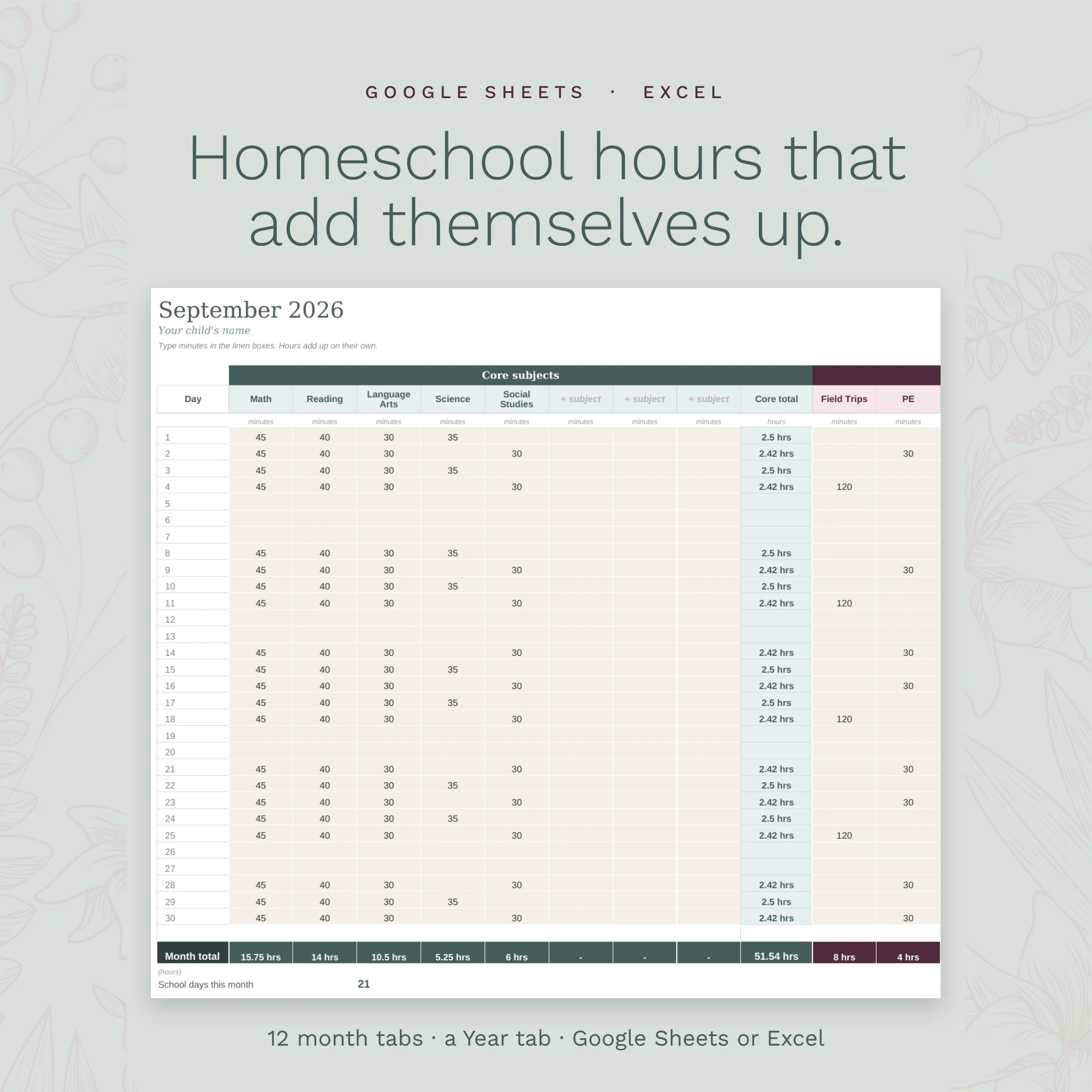
The Homeschool of One Hours Tracker
Type the minutes you spent on each subject, and the hours, school days and your progress toward your goal fill in on their own. One tab for each month, August to July, a Year tab and a Start Here tab. Works in Google Sheets or Excel.
$9 $6.75
New guides and printables, now and then
One email when something new and useful is ready. No sales every week.