
Keeping chicken water open when it freezes
Every way to keep a flock's water from freezing, from swapping two waterers to a heated base, with what each one needs, the fire and wiring rules from fire marshals and extension services, and a plan for when the power goes out. With a printable checklist.
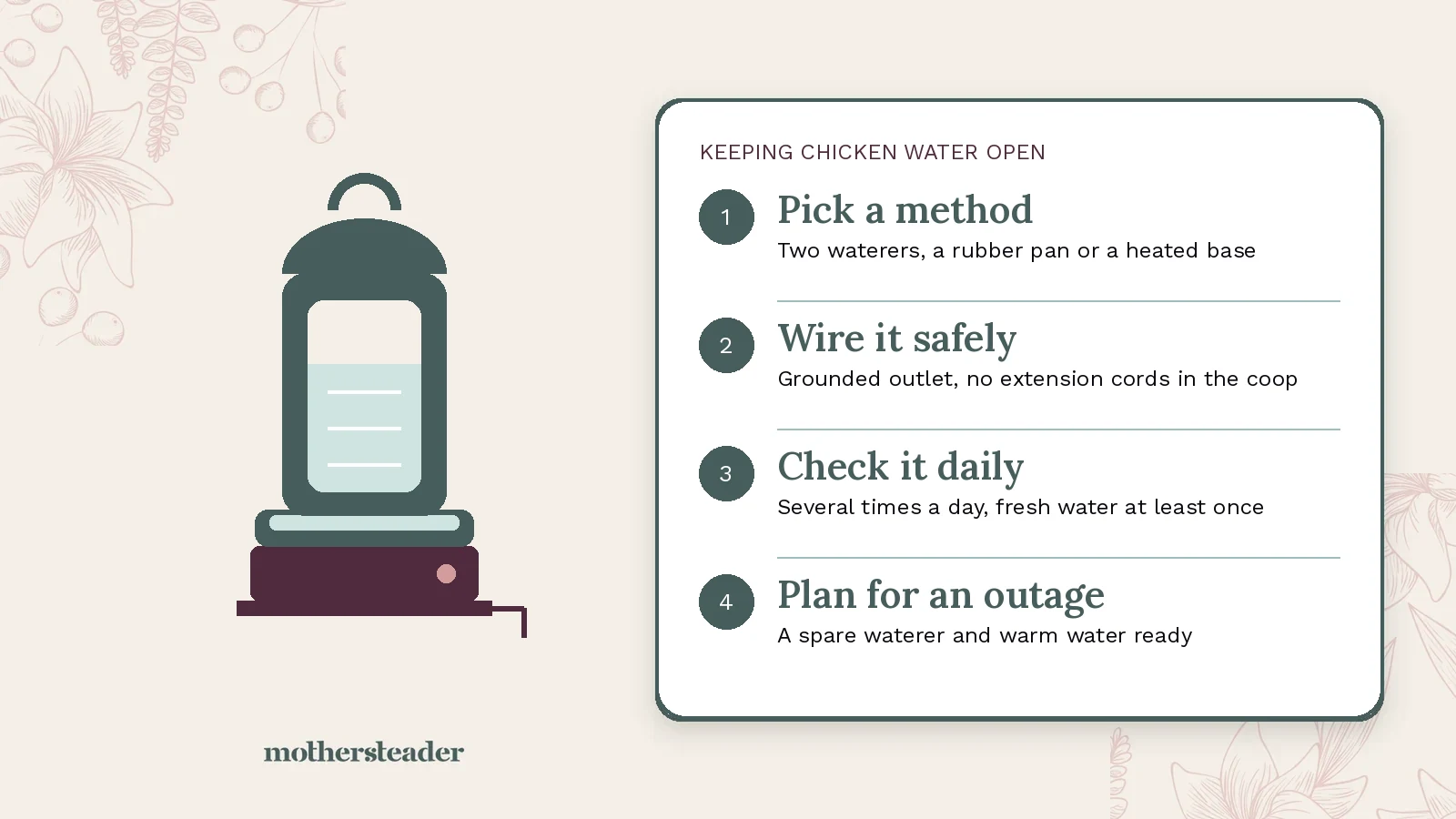
Water matters more in winter than most people expect. The University of Maryland Extension puts it plainly. Water that is frozen over is not available to the birds, and they can't break through the ice to reach it. The University of Maine Cooperative Extension says birds will suffer if they go without water for more than 10 hours, and the University of Illinois Extension says chickens need access to water at least every 10 hours, day and night.
They drink more than most people guess. The University of Wisconsin-Madison Extension says chickens generally drink about 2 pounds of water, about a quart, for every pound of feed they eat, and that an egg is more than 70% water. Maine's bulletin adds that birds need to drink water in order to keep warm, and that they typically need extra feed in cold and freezing temperatures.
This guide lays out every common way to keep water open, what each one needs, the fire and wiring rules that most "keep it from freezing" articles skip, and what to do when the power goes out and the heater goes with it. The printable checklist is at the end.
The ways to keep water open, side by side
There is no single right answer. It depends on whether you have power at the coop, how cold it gets, and how often someone can walk out there.
| Method | Needs power? | How it works | Watch for |
|---|---|---|---|
| Two waterers, swapped | No | One is in the coop while the other thaws inside (Wisconsin) | Someone has to be there to make the swap |
| Rubber pan | No | Frozen water pops out without damaging the pan (Wisconsin) | Needs fresh water each time you knock the ice out |
| Insulated container with warm water | No | Keeps warm water unfrozen for several hours (Wisconsin) | Several hours is not a whole night |
| Warm bricks in the waterer | No | Bricks warmed and placed inside the water container (Maine) | Same as above, it buys time rather than a full day |
| Heated base under a metal fount | Yes | The base sits under the waterer and keeps it from freezing (Maryland, Wisconsin, UNH) | Needs an outlet, and the cord has to be kept away from birds, water and litter |
| Heated plastic fount or heated bowl | Yes | The heater is built into the waterer or bowl (Illinois, UNH) | A heated dog dish works if it is partly covered so birds can't step in or drown (UNH) |
| Heat lamp over the waterer | Yes | The lamp keeps the water warm (Maryland, UNH) | Fire risk, and cold water splashed on a hot bulb can shatter it (Maryland). Read the next section first |
If you use a nipple waterer, Maine's bulletin suggests changing to copper nipples, because plastic ones might break in freezing temperatures.
Fire and wiring come first
Many guides to unfrozen water mention fire in a line or two. Fire officials say more, and it is worth reading before anything gets plugged in.
Heat lamps
Maine's bulletin says to be aware of any potential fire hazards when using heaters and heat lamps, to use the red infrared type if you use a heat lamp, and to hang it with chains, not rope. The National Fire Protection Association's coop tips, as published by Clark County, Washington, say to make sure heat lamps are properly secured, and that relying on the spring clamp alone is not enough to keep a lamp from coming loose. Idaho's State Fire Marshal says to keep heat lamps away from anything that can burn. In a coop, that includes the bedding, the nest boxes and the dust.
Because a heated base or heated waterer warms the water itself, without a hot bulb hanging over dry bedding, we would choose one of those over a heat lamp for water.
Cords and outlets
- Idaho's State Fire Marshal says not to use extension cords in the coop, and to make sure the cord and plug are properly grounded. The NFPA tips say the same about extension cords and add to choose electrical equipment made for agricultural or commercial use.
- The University of Illinois Extension says to keep the cords and connections of heaters and heated bowls off the floor and out of the chickens' reach.
- UNH Extension's answer on Ask Extension passes on a University of Minnesota rule to keep all wires away from poultry, water and flammable litter.
- South Dakota State University Extension's advice for heated stock tanks applies here too. It says to inspect heater cords regularly for wear, and to protect cords from being chewed on, driven on and stepped on.
- If a cord has to run somewhere outside the coop, the Electrical Safety Foundation International says to use one marked for outdoor use, to treat it as temporary rather than permanent wiring, not to overload it, never to use one that feels hot or is damaged, and never to plug power strips into each other.
The lasting fix for a coop with no outlet is a properly installed, grounded one. That is a job for an electrician.
Dust and cobwebs
Coops are dusty. The NFPA tips say to brush cobwebs and dust from light fixtures and outlets on a regular basis, and SDSU Extension notes that dust and cobwebs can be flammable. Wipe off the heated base and its plug when you clean the waterer.
The daily routine
Whatever method you choose, the water still needs a person.
- Check it several times a day. The University of Maryland Extension says to check the water several times a day and make sure it is not frozen.
- Give fresh water at least daily. Wisconsin says chickens need fresh water at least daily, and twice a day if you have no heated base, insulated container or other way to keep it thawed.
- Raise it up. UNH Extension suggests setting the waterer on a stand so bedding and manure stay out of it, while keeping it clear of the heating element.
- Watch for leaks and spills. Maine says to watch for leaks on waterers that freeze, and Illinois says to check daily for spills and leaks because they add moisture to the coop. Maine says wet or frozen bedding should be removed and replaced with clean, dry shavings.
- Keep it clean. Maine's bulletin says to keep feeders, roosts, nests and waterers clean and to remove dirty water right away.
When the power goes out
A heated base is only as good as the power line it hangs on, and winter storms take the power out. Plan the backup before you need it.
- Keep the spare waterer clean and ready, so the swap Wisconsin describes is your plan B.
- Know where you will get warm water if your water comes from a well with an electric pump. An insulated container of warm water stays unfrozen for several hours (Wisconsin). Count the flock when you decide how much water to store for the house.
- Go out more often. Maryland's several checks a day become the whole plan when nothing is heating the water.
- When the power comes back, check that the heated base is working before you leave it overnight.
The checklist
Print it and keep it by the coop door or with the feed.
Winter water checklist for a small flock
Before the first hard freeze
- Method chosen for each waterer, with a backup that needs no power
- Spare waterer, or a rubber pan, clean and ready
- Copper nipples in place of plastic, if you use a nipple system
- Heated base or heated waterer checked for cord wear before use
- Grounded outlet at the coop, no extension cords inside it
- Cords off the floor and away from birds, water and litter
- Heat lamps, if any, secured with chains and more than the spring clamp, away from bedding
- Light fixtures and outlets brushed free of dust and cobwebs
- Waterer on a stand, clear of bedding and the heating element
Every day
- Water checked several times, not frozen
- Fresh water at least once, twice if nothing keeps it thawed
- Leaks and spills checked, wet or frozen bedding replaced
- Dirty water removed, waterer clean
- Cord and plug looked at, nothing chewed, hot or damaged
When the power goes out
- Spare waterer swapped in, frozen one brought inside to thaw
- Warm water in an insulated container, refilled before it freezes
- Extra trips to the coop until the power is back
- Heated base checked once the power returns, before nightfall
From mothersteader.com. Sources are listed with the full guide.
One more chore that keeps the winter easy
Water is the daily job, but it is not the only one. If you want the whole winter laid out the same way, month by month for the animals, the water lines, the barn, the house and the vehicles, that is what the Winter Homestead Checklist is for. And if there are children at your place who like the hens, the Homestead Unit Study: The Chicken turns the flock into two weeks of lessons.
We send one email when a new guide or printable is ready. Sign up below if you'd like the next one.
Sources
- Winter Weather and Small Flocks (FS-1133) (University of Maryland Extension)
- Bulletin #2217, Winter Care of Your Laying Hens (University of Maine Cooperative Extension)
- How to care for backyard chickens in winter (December 12, 2020) (University of Illinois Extension)
- Preparing for Winter (University of Wisconsin-Madison Extension)
- Ask Extension question 938139, keeping chickens' water from freezing (answered July 8, 2026) (UNH Extension, via Ask Extension)
- Electrical Safety in the Barn (updated February 9, 2024) (South Dakota State University Extension)
- Chicken Coop Safety (Idaho Department of Insurance, State Fire Marshal)
- Safety tips to prevent a chicken coop fire (May 6, 2021; tips from the National Fire Protection Association) (Clark County, Washington)
- Extension Cord Safety (Electrical Safety Foundation International)
From the shop
Winter Homestead Checklist
Get the whole place ready for a northern winter, one month at a time. The animals, the water lines and the barn alongside the house and the vehicles, November to February, with a water and shelter log and cold-snap cards for the door. 12 fillable pages.
$5.75 $4.31
New guides and printables, now and then
One email when something new and useful is ready. No sales every week.