
A pantry that carries a family through a hard month
How to build a month of food your family already eats, a little at a time: plan it by meals, store it where it keeps, rotate it oldest first and check it every few weeks. With a printable one-month pantry checklist.
A hard month can come from anywhere. A blizzard that closes the road, a layoff, a surgery, a truck that needs a new transmission the same week the propane bill comes. A pantry doesn't fix any of that. It takes one big worry off the table so the family can deal with the rest.
This guide is about building that pantry the slow, cheap way: out of food your family already eats, bought a little at a time, kept where it lasts and used before it gets old. The printable checklist is at the end.
How much the public guides say to keep
The official numbers are smaller than a month, and it helps to know them first.
- Ready.gov says to "store at least a several-day supply of non-perishable food."
- The American Red Cross lists food and water as a "2-week supply for home."
- FEMA and the Red Cross, in their guide Food and Water in an Emergency, say: "Even though it is unlikely that an emergency would cut off your food supply for two weeks, consider maintaining a supply that will last that long."
So two weeks is the longest line the emergency agencies draw. A month is our suggestion for a household that lives far from town or on a tight budget, where a hard stretch can come from money or snow as easily as from a disaster. Build to two weeks first. Then keep going.
Plan it by meals, not by cans
Most pantry lists are long lists of food. The trouble is that a shelf of random cans doesn't add up to dinner. Planning by meals does.
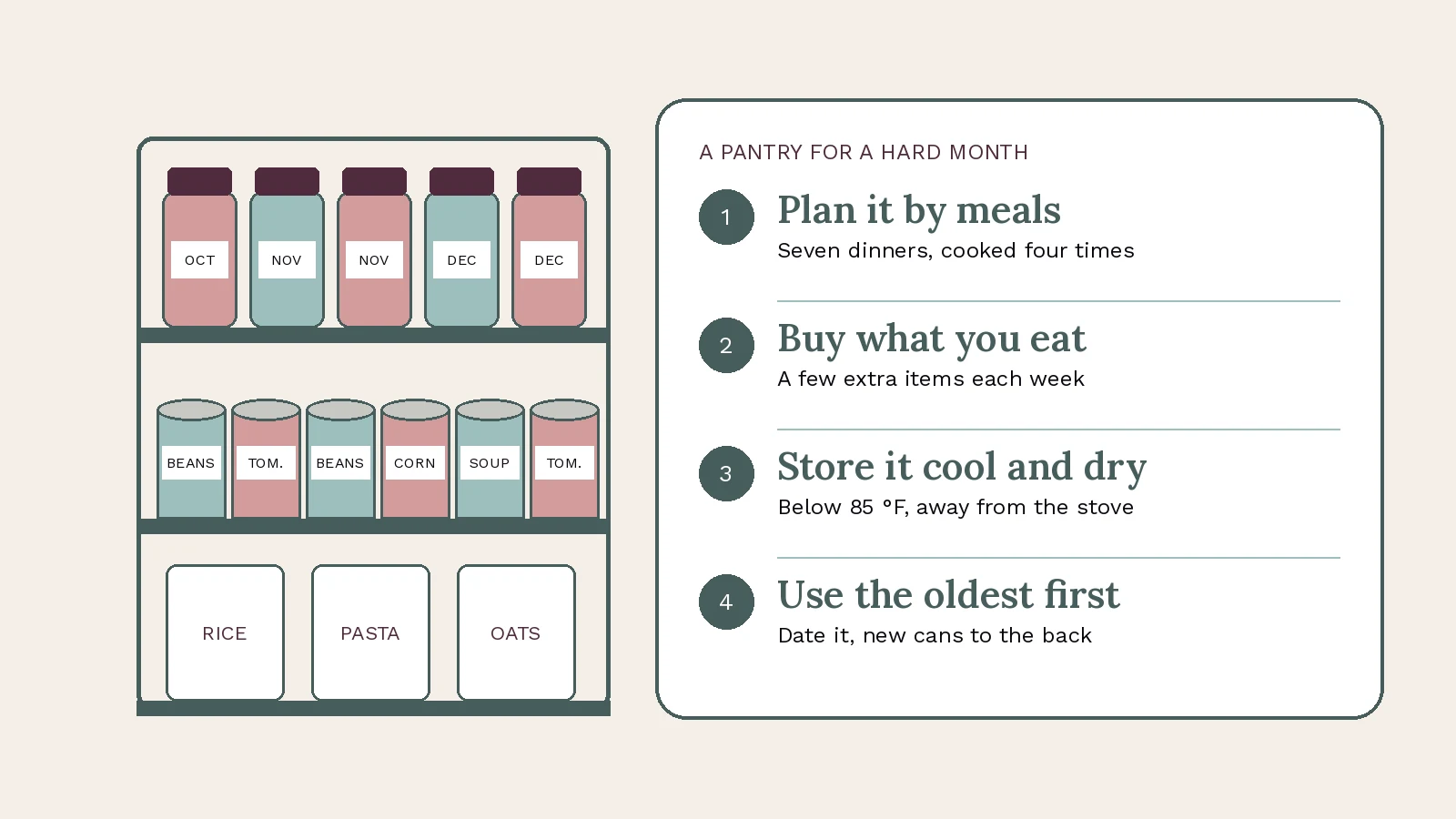
- Write down seven dinners your family eats now that can be made from shelf food, or from shelf food plus what is in your freezer. Chili with beans, spaghetti with jarred sauce, rice and beans, tuna casserole, pancakes, soup and crackers, baked beans with cornbread.
- Multiply by four. Seven dinners cooked four times each is 28 dinners, close to a month. Add two spare dinners for the days nothing goes right.
- Do the same for breakfast and lunch, with three or four of each. People eat the same breakfast most days, so this part is short.
- Turn each meal into a shopping line. If chili takes two cans of beans, one can of tomatoes and a pound of meat from the freezer, then four chili dinners is eight cans of beans, four cans of tomatoes and four pounds of meat.
That last step is the whole system. You end up with a list where every item has a reason to be there, and a number to stop at.
Ready.gov's advice fits this exactly: "Choose foods your family will eat" and "Remember any special dietary needs." FEMA adds why it matters: "Familiar foods are important. They lift morale and give a feeling of security in times of stress."
A worked example for one meal
| Meal (cooked 4 times) | Shelf food for one dinner | For the month |
|---|---|---|
| Chili | 2 cans beans, 1 can tomatoes, chili spices, plus 1 lb meat from the freezer | 8 cans beans, 4 cans tomatoes, spices, 4 lb meat |
| Spaghetti | 1 lb pasta, 1 jar sauce | 4 lb pasta, 4 jars sauce |
| Rice and beans | 2 cups rice, 2 cans beans | 8 cups rice, 8 cans beans |
Amounts are for illustration. Use what your own recipes call for and how much your family actually eats.
Build it a little at a time
A month of food bought in one trip is a big bill. USDA's Thrifty Food Plan put the monthly cost of food for its reference family of four (two adults and two children) at $1,024.00 for September 2026. Nobody needs to spend that on top of normal groceries.
The cheaper way is to buy a little extra every week. Pick two or three items from your list and buy one more than you need. Bit by bit the shelf fills, without one big grocery bill. When pasta, rice or beans go on sale, that is the week to buy more of them.
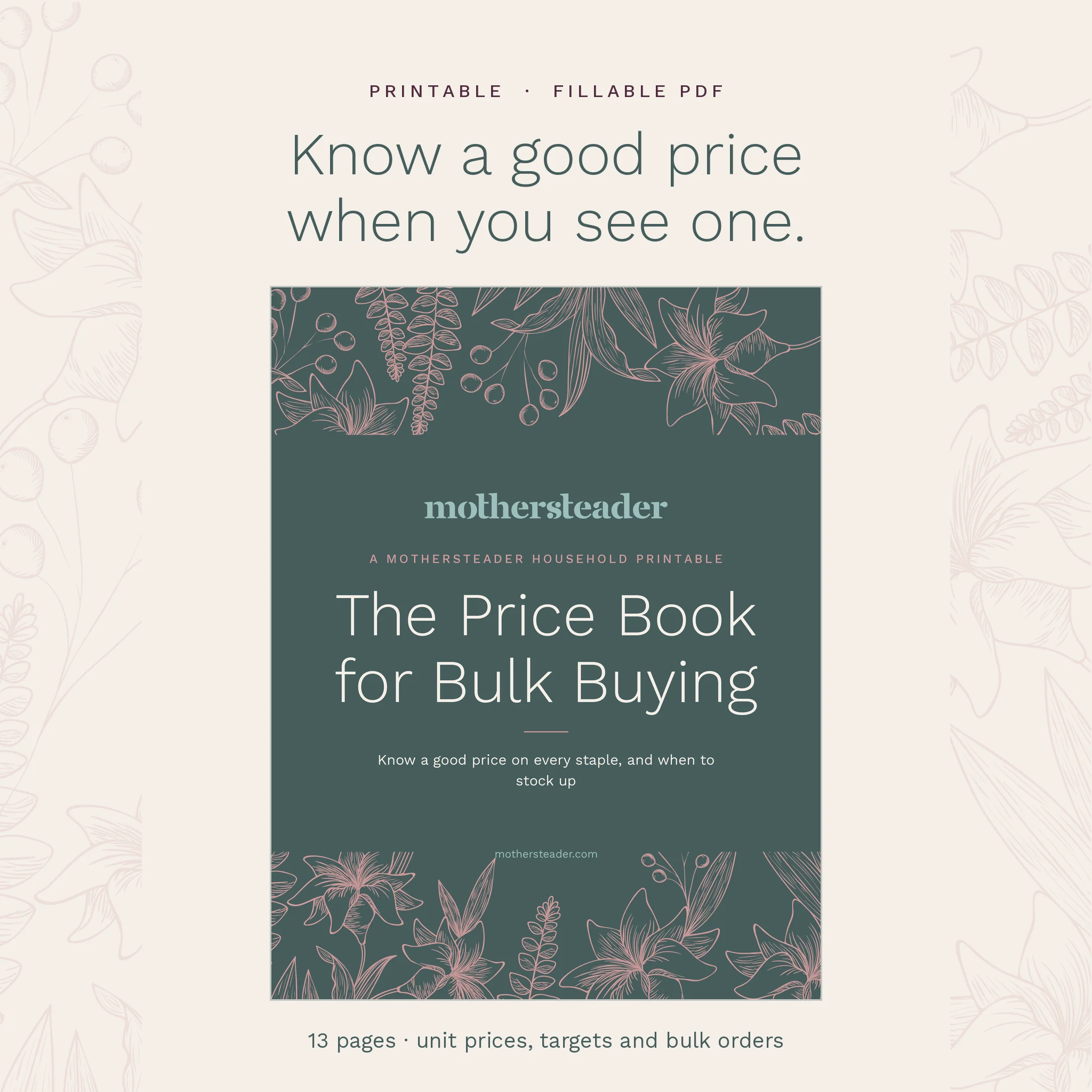
A price book helps here. Write down what your usual items cost at each store, and you will know a real sale when you see one. Our Price Book for Bulk Buying is a printable made for exactly that.
Store it where it keeps
USDA's Food Safety and Inspection Service (FSIS) gives the storage rules for canned and shelf-stable food:
- "Store canned foods and other shelf stable products in a cool, dry place."
- "Temperatures below 85 degrees F are best."
FEMA also says to keep food in a dry, cool spot, and a dark one if possible. FSIS adds: "Never put them above or beside the stove, under the sink, in a damp garage or basement, or any place exposed to high or low temperature extremes." That rules out the spot beside the woodstove or furnace and an unheated shed where cans can freeze. A closet on an inside wall often works well.
How long canned food keeps on the shelf
FSIS gives these storage times for commercially canned food on the shelf:
| Kind of canned food | Examples FSIS gives | Storage time on the shelf |
|---|---|---|
| High-acid | Tomatoes, pineapple, pickles | 12 to 18 months |
| Low-acid | Meat, beans, corn | 2 to 5 years |
Home-canned food follows its own rules. If you put up your own, follow a tested recipe and the storage guidance that comes with it. The Canning Pantry, our canning planner and recipe book, is built on tested recipes.
Check the cans
FSIS is plain about damaged cans:
- "Don't purchase bulging, rusted, leaking, or deeply dented cans."
- "If a can containing food has a small dent, but is otherwise in good shape, the food should be safe to eat."
- "Discard deeply dented cans," "any can with a deep dent on any seam," and "heavily rusted cans."
- "Do not use any swollen cans; discard them."
Use the oldest first
A pantry that never gets eaten turns into a shelf of expired food. The fix is rotation, and FEMA and the Red Cross spell it out: "Use foods before they go bad, and replace them with fresh supplies, dated with ink or marker. Place new items at the back of the storage area and older ones in front."
FSIS says the same thing in fewer words: "Check your pantry every few weeks and use canned goods you have had on hand for awhile."
Three habits make it work:
- Date everything as it comes in. A marker on the lid or the can is enough. If you can at home, our Canning Jar and Pantry Labels put the canned date on every jar and label your shelves and bins.
- Shop from the front, stock from the back. When you cook, take from the front of the shelf. When you unpack groceries, new cans go behind.
- Cook from the pantry one week a month. It uses up the oldest food, shows you what your family is tired of, and tells you what to buy more of.
Don't forget the rest
- Water. Ready.gov says to "store at least one gallon of water per person per day for several days, for drinking and sanitation," and the Red Cross says a 2-week supply for home.
- A manual can opener. Ready.gov, FEMA and the Red Cross all name it. Keep one with the pantry, not in the kitchen drawer.
- Pets. FEMA says, "Don't forget nonperishable foods for your pets."
- Babies. Ready.gov lists "Food for infants" among emergency supplies. Put whatever your baby eats on the meal list too.
- Cooking without power. Much of this list needs a stove. If yours is electric, our winter power-outage plan covers getting a rural household through the outage itself. FoodSafety.gov says, "A full freezer will hold a safe temperature for approximately 48 hours (24 hours if it is half full and the door remains closed)."
One-month pantry checklist
Plan
- Seven dinners we eat now, written down
- Three or four breakfasts and lunches written down
- Each meal turned into a shopping line, times four
- Two spare dinners added
- Special diets, baby food and pet food on the list
Build
- Two or three extra items bought each week
- Sale prices for pantry staples written in a price book
- Two-week supply reached
- One-month supply reached
Store
- Shelf in a cool, dry, dark place, away from stoves and freezing
- No bulging, rusted, leaking or deeply dented cans
- Every item dated as it comes in
- Manual can opener kept with the pantry
Keep it fresh
- New items in back, oldest in front
- One week a month cooked from the pantry
- Pantry checked every few weeks; anything old used first
- Water stored, at least one gallon per person per day
From mothersteader.com. Sources are listed with the full guide.
More for a prepared home
The preparedness page of the blog has our other guides, starting with the winter power-outage plan.
We send one email when a new guide or printable is ready. Sign up below if you'd like the next one.
Sources
- Food (Ready.gov)
- Water (Ready.gov)
- Shelf-Stable Food Safety (USDA Food Safety and Inspection Service)
- Food Safety During Power Outage (FoodSafety.gov)
- What Do You Need In a Survival Kit (American Red Cross)
- Food and Water in an Emergency (FEMA and the American Red Cross)
- Official USDA Thrifty Food Plan: U.S. Average, September 2026 (USDA)
From the shop
Price Book for Bulk Buying
Know a good price on every staple, and when to stock up: how to work out a unit price, a unit converter, price targets for your staples, eight item price pages, a store comparison, a bulk and co-op order log with an order split, a stock-up planner and quick deal checks. 13 fillable pages.
$5 $4
New guides and printables, now and then
One email when something new and useful is ready. No sales every week.