
A winter power-outage plan for a rural household
What to set up before winter, what to do in the first hours, and how to decide about food when the lights come back, written for a household on a well, with animals and a long road in. With a printable checklist.
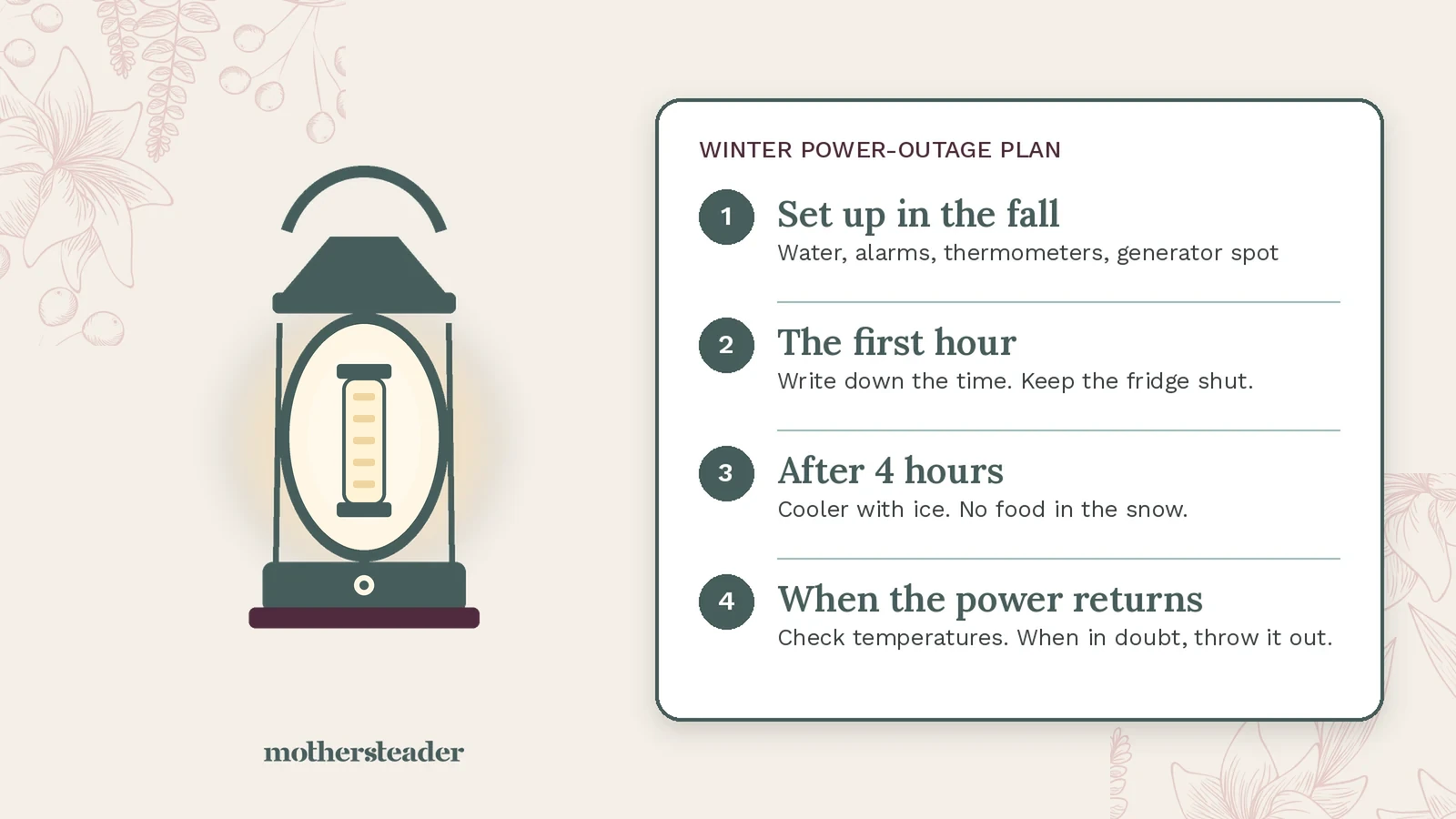
In town, a winter outage is mostly dark and cold. Out of town it reaches further. If your water comes from a well with an electric pump, the tap stops when the power does. Stock tank heaters and heat lamps go cold, and the freezer full of the year's meat starts its clock. The furnace or boiler may stop too, so find out now whether yours needs electricity to run.
None of that needs to turn into a crisis. Most of a good outage plan is done once, on a calm afternoon in the fall. This guide walks through that afternoon, the first hours of an outage, and the food decisions when the lights come back, with a printable checklist at the end.
Set it up once, before winter
Water for people and animals
If you are on a well, stored water is the whole plan. Ready.gov says to store at least one gallon of water per person per day for several days, for drinking and sanitation, and the American Red Cross suggests keeping food and water for at least two weeks. With the pump off, sanitation includes flushing, so on a well it makes sense to store more than the minimum. When a storm is forecast, Michigan's state preparedness site says to fill the bathtub and spare containers with water if your supply could be affected, such as a well pump. That water is for washing and flushing. Count the animals' water too, and keep it somewhere it will not freeze solid. The Winter Homestead Checklist has a water and shelter log for the cold weeks and a power-out card for the door.
List what needs power, then rank it
Ready.gov suggests taking an inventory of the things you rely on that use electricity. FEMA's printed information sheet says to plan which things you will plug in first, because you may not be able to power everything at once. On a homestead that list might include the well pump, a stock tank heater, the fence charger, the furnace and the freezer. Decide the order now, while nobody is cold.
Alarms that work without the grid
FEMA's information sheet recommends smoke and carbon monoxide alarms with battery backup, if they are hardwired, on every level of the home and near sleeping areas. The CDC recommends battery-operated or battery backup CO detectors near every sleeping area, with the batteries checked when you change the clocks in spring and fall. During an outage people bring generators, heaters and stoves closer to the house, so the CO alarm earns its place.
Fridge and freezer, before you need them
- Put an appliance thermometer in the refrigerator and the freezer. USDA FSIS says the refrigerator should be at 40 F or below and the freezer at 0 F or below.
- Keep the freezer full. FSIS suggests filling empty spaces with frozen jugs of water, bags of ice or gel packs, and having a large insulated cooler and frozen gel packs on hand.
- Find out now where you could buy dry ice or block ice (FSIS).
Medical needs
If anyone in the house uses a medical device that needs electricity, or a medicine that must stay cold, Ready.gov says to talk to your medical provider about a power outage plan and to find out how long the medicine can be stored at higher temperatures.
The generator, decided in daylight
Choose the spot now, when it is light and calm. The CDC says to run a generator outside, more than 20 feet from windows, doors and vents, and never inside the home or garage, even with the doors and windows open.
How it connects matters as much as where it sits. The American Red Cross says never to power the house wiring by plugging a generator into a wall outlet. This is called backfeeding, and it puts utility workers, your neighbors and your own household at risk of electrocution. If you want the generator connected to the house, have an electrician install a transfer switch. Otherwise, plug appliances straight into the generator or use a heavy-duty, outdoor-rated extension cord (American Red Cross). Ready.gov adds two more rules. Keep the generator dry, because touching a wet generator or anything plugged into it can cause electrical shock. Let it cool before refueling, because fuel spilled on hot engine parts can ignite.
Pipes, light, fuel and people
- In hard cold, the Red Cross suggests dripping cold water from faucets on exposed pipes and opening cabinet doors so warmer air reaches the plumbing. On a well, dripping only works while the power is on. Thaw a frozen pipe with an electric heating pad, a hair dryer or towels soaked in hot water, never a blowtorch or open flame, and call a licensed plumber if you can't find or reach the frozen spot. Know where your main water shutoff is and how to close it (MI Ready, State of Michigan).
- Use flashlights, not candles (American Red Cross). Keep them and spare batteries where you can find them in the dark.
- Keep a battery-powered or hand-crank radio with the flashlights (Ready.gov, American Red Cross).
- NHTSA suggests keeping your vehicle's gas tank close to full whenever possible, and FEMA's information sheet says to make sure it has plenty of fuel before forecast extreme weather.
- Charge phones when a storm is coming and keep your contact plan on paper, as FEMA's information sheet advises. It also notes that a landline will not work if the lines are damaged. Agree now who checks on whom.
When the power goes out
The first hour
- Write down the time. The USDA FSIS food rules count from the moment the power went off.
- Keep the refrigerator and freezer closed. FSIS says the refrigerator will keep food safe for up to 4 hours, and a full freezer holds its temperature for about 48 hours (about 24 hours if it is half full).
- Unplug appliances and electronics so a surge does not damage them when the power returns (Ready.gov).
Staying warm without poisoning the air
This is where outages hurt people, so it is worth reading twice.
- Never heat the house with a gas oven or stovetop (CDC, Ready.gov). FEMA's information sheet adds the grill and the clothes dryer to that list.
- Never use a grill, camp stove or other fuel-burning device inside (American Red Cross and CDC), and do not use portable flameless chemical heaters indoors (CDC). That includes the basement and the garage.
- Do not cook or burn anything in a stove or fireplace that is not vented (CDC).
- Use fireplaces, wood stoves and space heaters safely (FEMA information sheet), and keep anything that could catch fire at least 3 feet from the heat (American Red Cross). The CDC recommends having the chimney checked or cleaned every year, so book that in the fall.
- If the house gets too cold, go somewhere with heat, such as a friend's house, a library or a warming center (American Red Cross). Ready.gov suggests checking with local officials about warming locations near you.
The car is not a heater in the garage
FEMA's information sheet says never to leave a vehicle running inside a garage, even with the garage door open. If you use the vehicle for power or warmth, run it in a well-ventilated place outside. NHTSA's advice for a car stuck in snow applies here as well. Make sure the exhaust pipe is clear of snow, and run the engine only now and then, just long enough to stay warm.
Downed power lines
Winter storms bring lines down. Stay at least 35 feet away from a fallen power line and anything it is touching (American Red Cross). Texas Co-op Power, published by that state's electric cooperatives, says to assume a downed line is live even if you see no sparks, and to call 911 and your electric cooperative when you see one. If a line falls on your car, stay inside and call 911. Get out only if there is a risk of fire. Open the door, jump completely clear with both feet together so you never touch the car and the ground at the same time, then hop or shuffle away with both feet on the ground (Texas Co-op Power).
To report the outage itself, call your electric co-op or utility. MI Ready, the State of Michigan's preparedness site, says never to call 911 to ask about a power outage.
After four hours
If the power is still off after 4 hours and you have a cooler, FSIS suggests moving the refrigerated food into it with enough ice or frozen gel packs to keep it at 40 F or below. Add ice as it melts. Leave the freezer shut.
- Do not put food out in the snow. FSIS explains that outdoor temperatures vary and food can be exposed to animals and unsanitary conditions. Make ice instead. Fill buckets, empty milk jugs or cans with water, set them outside to freeze, and use that ice in the refrigerator, freezer or coolers.
- For a long outage, FSIS notes that 50 pounds of dry ice should hold an 18-cubic-foot freezer for 2 days. Do not touch dry ice with bare hands or let it touch food.
Look in on people
FEMA's information sheet asks you to check on family members and neighbors if it is safe to do so. In the country, the people down the road may be the only ones who can get there.
When the power comes back
Food comes first, because guessing is how people get sick. These are the USDA FSIS rules, and the thermometers you put in the fridge and freezer in the fall make them easy to follow.
| Where | What you find | What to do |
|---|---|---|
| Refrigerator | Power back within 4 hours, door kept shut, thermometer at 40 F or below | Keep the food |
| Refrigerator | Power off more than 4 hours, and the food was not kept at 40 F or below in a cooler | Throw out perishables, including meat, poultry, fish, eggs, milk, cream, yogurt, soft cheese, leftovers, casseroles, soups, and cut fruit and vegetables |
| Cooler | Food kept at 40 F or below with ice the whole time | Keep the food |
| Freezer | Thawed food that still has ice crystals, or has stayed at 40 F or below | Safe to refreeze, though the quality may suffer |
| Anywhere | An unusual odor, color or texture | Throw it out |
The full FSIS discard list is longer, with luncheon meat and hot dogs, gravy and stuffing, opened juices, custard, chiffon or cheese pies, and cream-filled pastries among them. It is linked in the sources below.
FSIS also lists foods that are usually fine to keep unless they turn moldy or smell off: hard and processed cheeses, butter and margarine, whole fresh fruits and vegetables, unopened juices, bread, rolls and fruit pies, and high-acid foods such as mustard, ketchup, pickles, jams and jellies, which may spoil sooner.
Never taste food to decide whether it is safe. When in doubt, throw it out (USDA FSIS).
The guides do not all use the same clock. Ready.gov's web page says to throw out food that has been at 40 degrees or higher for two hours or more, and FEMA's printed information sheet allows up to 4 hours. When a thermometer shows the food has warmed, we go by the shorter time.
After the food
- Replace refrigerated medicines if the power was out for a day or more, unless the label says otherwise. FEMA's information sheet adds, "Call your doctor or pharmacist if you depend on refrigerated medications that have been at room temperature. Only use the medicine until you have a new supply."
- Watch for water advisories, and boil water or use your stored water if one is issued (FEMA information sheet).
- Write down what went wrong while you still remember. The "What froze" page of the Winter Homestead Checklist has room for what went wrong, when, why, and what you will change before next winter.
The checklist
Print it and tape it inside a cupboard door, next to the flashlights.
Winter power-outage checklist
Before winter
- Food and water for at least two weeks, extra water for flushing, and water for the animals
- Main water shutoff found, and you know how to close it
- What needs power listed and ranked
- Smoke and CO alarms with battery backup on every level, batteries checked when the clocks change
- Thermometers in the refrigerator (40 F or below) and freezer (0 F or below)
- Freezer full, cooler and gel packs ready, a source of dry or block ice found
- Chimney checked or cleaned
- Flashlights, batteries and a battery or crank radio in a known place, no candles
- Generator spot outdoors, more than 20 feet from windows, doors and vents
- Generator never plugged into a wall outlet (transfer switch by an electrician, or heavy-duty outdoor cords)
- Medical devices and cold medicines planned with your provider
- Contact plan on paper, and who checks on whom agreed
- Vehicle tank kept close to full
- Bathtub and spare containers filled when a storm is forecast, if you are on a well
When the power goes out
- Time written down
- Refrigerator and freezer kept shut
- Appliances and electronics unplugged
- No gas oven, stovetop, grill, dryer or camp stove used for heat
- Generator outside and dry, cooled before refueling
- No vehicle running in the garage, even with the door open
- If the CO alarm sounds, get out and call 911
- Downed lines given 35 feet, 911 and the co-op called
- Outage reported to the co-op or utility, not 911
- After 4 hours, refrigerator food moved to a cooler with ice
- No food in the snow, buckets of water set out to freeze
- Family and neighbors checked on, if it is safe
When it comes back
- Fridge off over 4 hours without a cooler, perishables thrown out
- Freezer food with ice crystals, or at 40 F or below, refrozen
- Nothing tasted, and when in doubt, thrown out
- Cold medicines replaced after a day or more, unless the label says otherwise
- Water advisories checked
- What went wrong written down for next winter
From mothersteader.com. Sources are listed with the full guide.
One afternoon now, an easier night later
An outage plan is mostly small things done early. A thermometer goes in the freezer, a battery goes in the CO detector, and the generator spot gets picked in daylight. If you want the rest of the winter laid out the same way, month by month for the animals, the water lines, the barn, the house and the vehicles, that is what the Winter Homestead Checklist is for.
Sources
- Keep Your Food Safe During Emergencies: Power Outages, Floods & Fires (USDA Food Safety and Inspection Service)
- Power Outages (Ready.gov, FEMA)
- Be Prepared for a Power Outage (information sheet, FEMA V-1008, December 2023) (FEMA)
- Water (Ready.gov, FEMA)
- Build A Kit (Ready.gov, FEMA)
- Carbon Monoxide Poisoning Basics (updated January 12, 2026) (CDC)
- Prevention Guidelines: You Can Prevent Carbon Monoxide Exposure (CDC)
- Power Outage Safety (American Red Cross)
- Safe Generator Use (American Red Cross)
- How to Prevent & Thaw Frozen Pipes (American Red Cross)
- Winter Storm Preparedness (American Red Cross)
- Winter Power Outage Tips (MI Ready, State of Michigan)
- Downed Power Lines Never Safe (May 2020) (Texas Co-op Power, Texas Electric Cooperatives)
- Winter Driving Tips (NHTSA)
From the shop
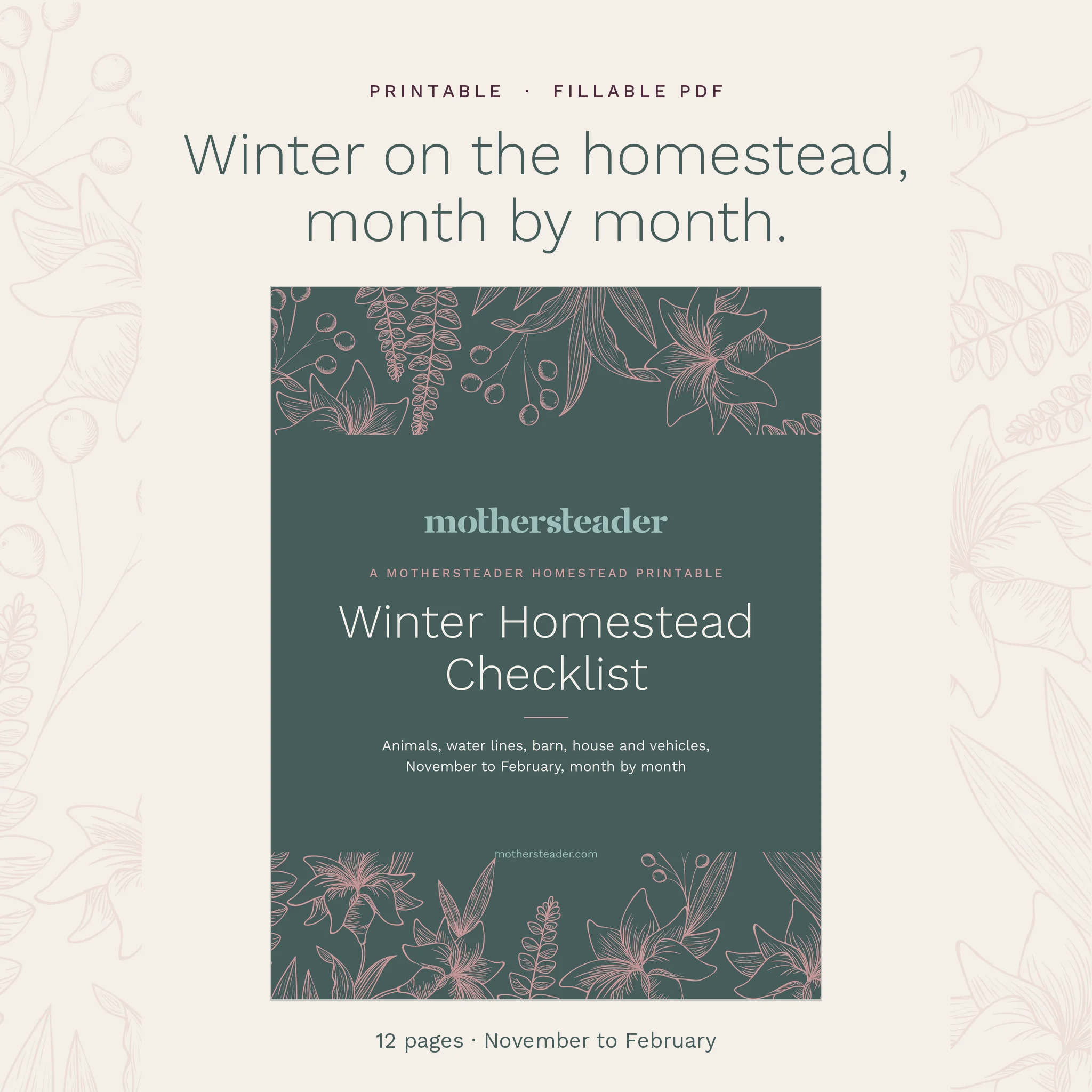
Winter Homestead Checklist
Get the whole place ready for a northern winter, one month at a time. The animals, the water lines and the barn alongside the house and the vehicles, November to February, with a water and shelter log and cold-snap cards for the door. 12 fillable pages.
$5.75 $4.31
New guides and printables, now and then
One email when something new and useful is ready. No sales every week.