
How long venison and other game keep in the freezer, by cut
What USDA FSIS actually says about frozen wild game, cut by cut: why frozen venison stays safe, how long each kind of package keeps its best quality, and a simple way to eat the whole animal before it gets old. With a printable game freezer plan.
A deer or an elk can take up a lot of freezer space in one afternoon. Then the questions start. How long is this good for? Is last year's ground still all right? Should the steaks go first, or the burger?
Search for an answer and you will find numbers all over the map. One site says ground venison keeps 3 to 4 months, the next says 9 to 12, and another says vacuum sealed meat is good for two years. Most of them don't say where their number came from.
The short answer from USDA is that uncooked wild game keeps its best quality 8 to 12 months at 0 °F, and stays safe as long as it stays frozen. Ground meat, sausage and cooked meat have shorter windows.
This guide sticks to one source, the USDA Food Safety and Inspection Service (FSIS), and turns its freezer chart into a plan you can use for a whole animal. The printable game freezer plan is at the end.
First, frozen game stays safe
FSIS draws a clear line between safety and quality. In its guide Freezing and Food Safety it says, "Food stored constantly at 0 °F will always be safe. Only the quality suffers with lengthy freezer storage." Its freezer chart carries the same note, "Freezer storage is for quality only. Frozen foods remain safe indefinitely."
So the months in the table below are not a deadline for throwing food out. They tell you how long a package keeps its best flavor and texture. After that, meat slowly dries out and can pick up off flavors.
Two things make that promise hold:
- The freezer has to stay at 0 °F or colder. FSIS also says to "store all foods at 0° F or lower" for the best quality, and to keep an appliance thermometer in the freezer, which matters most after a power outage or a breakdown.
- The meat has to stay frozen the whole time. The safety promise is for food stored constantly at 0 °F. Thawing and refreezing has its own rules, covered below.
How long each cut keeps its best quality
FSIS gives one line for wild game. Uncooked wild game keeps its best quality for 8 to 12 months at 0 °F. It does not list venison cuts one by one, so for the packages it doesn't name, we use the line from the same chart that fits the package.
| What's in the package | The FSIS chart line we use | Best quality at 0 °F |
|---|---|---|
| Steaks, chops, backstrap and tenderloin | Wild game, uncooked | 8 to 12 months |
| Roasts | Wild game, uncooked | 8 to 12 months |
| Stew meat and trim, uncooked | Wild game, uncooked | 8 to 12 months |
| Ground meat | Meat, uncooked ground | 3 to 4 months |
| Fresh sausage | Bacon and sausage | 1 to 2 months |
| Cooked meat (leftover roast, cooked burger) | Meat, cooked | 2 to 3 months |
| Chili, soup or stew | Soups and stews | 2 to 3 months |
| Gravy | Gravy, meat or poultry | 2 to 3 months |
The ground meat line is our choice, not an FSIS rule for game. FSIS gives no separate line for ground game, so we plan ground venison on its line for uncooked ground meat, the shorter and more careful of the two. If you have heard that ground venison lasts longer, you may be right about your own freezer. We would still eat it first.
For steaks and roasts we use the wild game line because FSIS names wild game directly. The chart's general lines for uncooked meat steaks, chops and roasts give 4 to 12 months, so a plan that eats them within 8 months stays inside both.
The same chart covers elk, moose, antelope and any other wild game, since its line is for wild game in general.
Wrap it so it lasts
Freezer burn is a common way a package loses quality. FSIS calls it "grayish-brown leathery spots" caused by air touching the surface of the food, and says plainly that "freezer burn does not make food unsafe, merely dry in spots." You can cut the dry spots away before or after cooking. A package that is badly freezer burned may not be worth eating, for quality reasons.
What FSIS says about packaging:
- Meat can go into the freezer in its original wrap, but that wrap "is permeable to air and quality may diminish over time." For long storage, FSIS says to overwrap it.
- "Freeze unopened vacuum packages as is."
- If a package tears in the freezer, "the food is still safe to use; merely overwrap or rewrap it."
- Freeze it fast. FSIS says slow freezing makes large ice crystals that damage the meat, which "causes meat to 'drip' and lose juiciness" when it thaws. FSIS says that ideally a food 2 inches thick "should freeze completely in about 2 hours," and to "never stack packages to be frozen." Spread them out in one layer and stack them only after they are frozen solid.
FSIS gives no separate figure for vacuum sealed meat, so we plan vacuum sealed packages on the same months as everything else and count anything extra as a bonus.
Label every package the same way
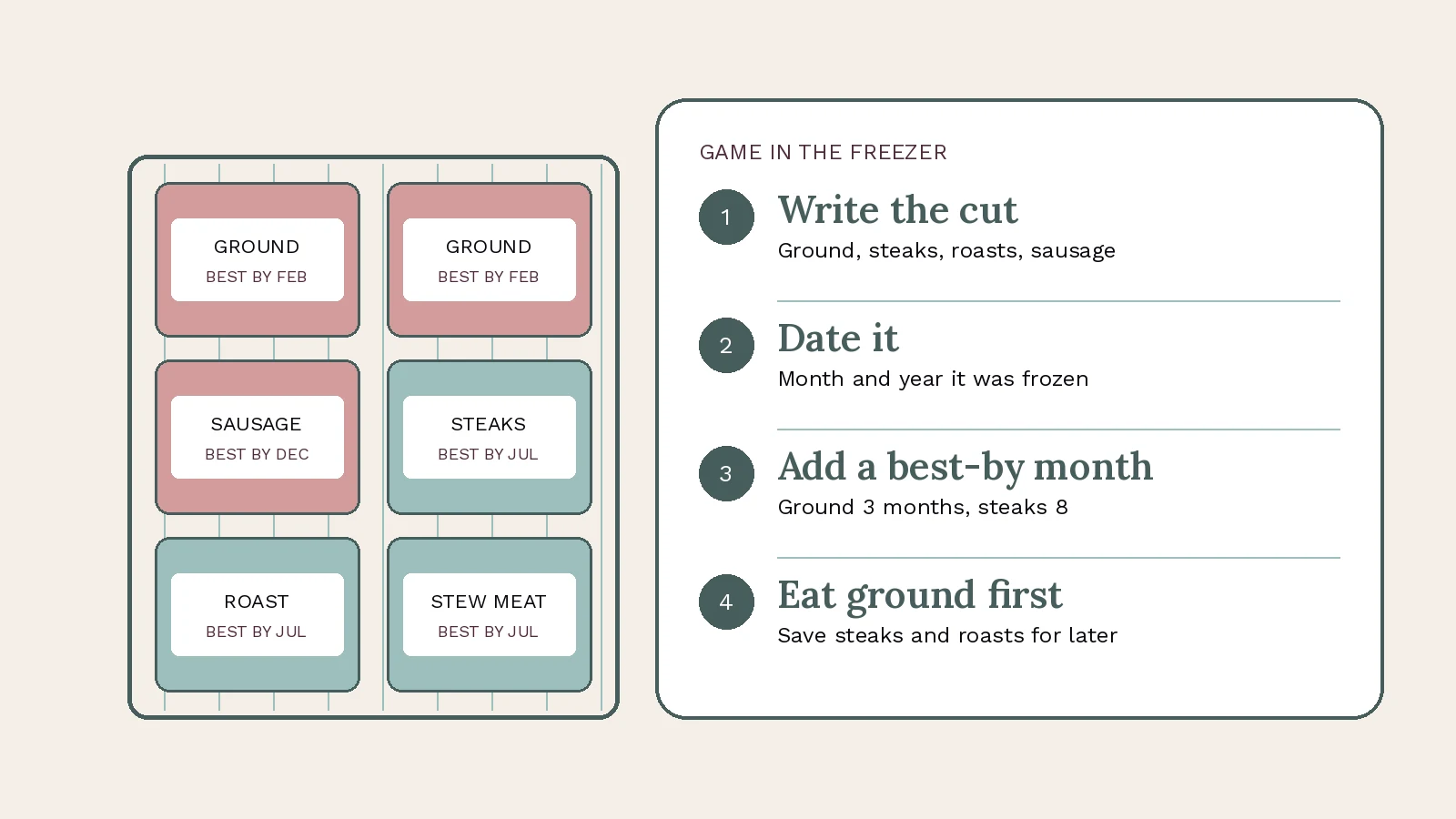
A label only helps if you can read it in a cold freezer in a hurry. Four lines are enough:
- The cut, such as ground, backstrap or shoulder roast.
- The animal, with the species and a tag number or a name you will remember, so packages from different animals don't get mixed up.
- The month and year it was frozen.
- A best-by month, which is the date frozen plus the shortest number of months in the table above.
That fourth line does the math for you once, at the counter, instead of every time you open the lid. For meat frozen in November 2026:
| Package | Shortest window (from the table above) | Best by |
|---|---|---|
| Ground | 3 months | February 2027 |
| Fresh sausage | 1 month | December 2026 |
| Steaks, roasts, stew meat | 8 months | July 2027 |
Our Freezer Labels and Freezer Map printable has fillable labels for the cut, the date frozen and a best quality date (the notes line can hold the animal), and a map of where everything sits in a chest or upright freezer.
Eat the whole animal before it gets old
Here is the simple plan we recommend. It rests on one fact from the table. Ground meat has the shortest window, and roasts and steaks the longest.
- Count your packages by cut the week the meat goes in.
- Divide each count by the weeks in its window. For example, 12 packages of ground with a 3 month window is about one package of ground a week.
- Eat ground and sausage first. Build the first weeks of meals around them.
- Save steaks and roasts for later in the year. They have the longest window, and they make good meals for holidays and company.
- Keep the oldest in front. When a new animal comes in, last year's packages move to the top or the front of the freezer.
The 8 to 12 month window for steaks and roasts is about one hunting season to the next, so the goal is a freezer that is close to empty of last year's meat by the time this year's comes home.
When a package is past its best-by month
It is still safe if it stayed frozen at 0 °F. For foods that are not on its chart, FSIS says you may judge quality after thawing, and you can use the same test for an old package. FSIS says to "first check the odor," and that some foods "will develop a rancid or off odor when frozen too long and should be discarded." It adds that food that doesn't look its best "may be edible; use them to make soups or stews." An older roast often does well in a long braise or chili.
Thaw it safely
FSIS names three safe ways to thaw meat: in the refrigerator, in cold water and in the microwave. It also says, "it is safe to cook foods from the frozen state," which takes about 50% longer than cooking thawed meat.
| Method | What FSIS says about time | Before refreezing |
|---|---|---|
| Refrigerator | Even a pound of ground meat needs a full day | Can be refrozen without cooking, with some loss of quality |
| Cold water | About a pound in an hour or less; a 3 to 4 pound package 2 to 3 hours; change the water every 30 minutes | Cook it first |
| Microwave | Cook right after thawing | Cook it first |
After a refrigerator thaw, FSIS says ground and stew meat stay good for "an additional day or two before cooking," and red meat roasts, chops and steaks for 3 to 5 days (it names beef, pork and lamb as its examples).
FSIS also says never to thaw meat on the counter, in hot water, or in a "garage, basement, car, dishwasher or plastic garbage bag," outdoors or on the porch.
If the power goes out
FSIS says "a freezer full of food will usually keep about 2 days if the door is kept shut; a half-full freezer will last about a day." Keep the lid closed, and push packages together if the freezer isn't full.
When the power comes back, FSIS says food that "is partly frozen, still has ice crystals, or is as cold as if it were in a refrigerator (40 °F)" is safe to refreeze or use. It also says to discard food that has been warmer than 40 °F for more than 2 hours.
Snow on the ground is not a freezer. FSIS warns that frozen food "can thaw if it is exposed to the sun's rays even when the temperature is very cold," and that animals can get into it. Our winter power-outage plan covers the rest of a rural outage, including the freezer.
Game freezer plan
When the meat comes home
- Freezer checked with a thermometer at 0 °F or colder
- Every package wrapped tight, torn wraps overwrapped
- New packages spread out in one layer until frozen hard
- Every package labeled with cut, animal, date frozen and best-by month
Count it
- Packages of ground counted (best by 3 to 4 months)
- Packages of fresh sausage counted (best by 1 to 2 months)
- Packages of steaks, roasts and stew meat counted (best by 8 to 12 months)
- Packages per week worked out for each cut
Eat it in order
- Ground and sausage first
- Steaks and roasts saved for later in the year
- Last year's packages moved to the front
- Freezer thermometer checked every week
Thaw it safely
- Thaw in the refrigerator, in cold water or in the microwave
- Cold water and microwave thaws cooked before refreezing
- Never thawed on the counter, in the garage or outdoors
From mothersteader.com. Sources are listed with the full guide.
Keep the whole record in one place
If you put up game every fall, The Cold Store keeps a freezer inventory and a game log in one Google Sheet, so every animal's record runs from tag to package and you can see what to eat first. For the rest of the shelf, our guide to a pantry that carries a family through a hard month works the same way. Plan it, date it and use the oldest first.
We send one email when a new guide or printable is ready. Sign up below if you'd like the next one.
Sources
- Freezing and Food Safety (USDA Food Safety and Inspection Service)
- The Big Thaw: Safe Defrosting Methods (USDA Food Safety and Inspection Service)
From the shop
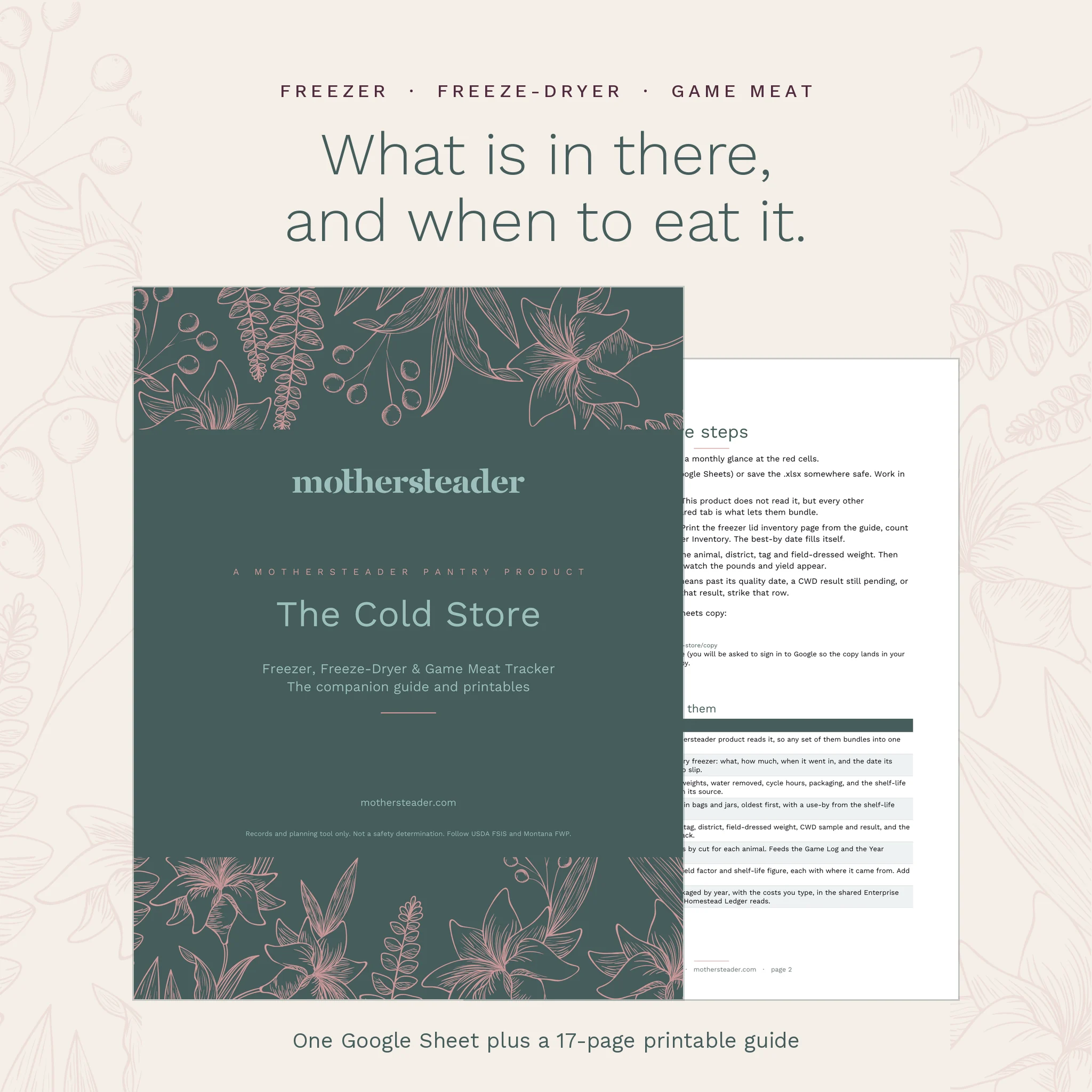
The Cold Store: Freezer, Freeze-Dryer & Game Meat Tracker
Know what is in the freezer, eat it while it is still good, and keep every animal's record from tag to package. One Google Sheet with a freezer inventory, a freeze-dryer batch log, a mylar and jar inventory and a game log, plus a 17-page printable guide.
$14 $10.50
New guides and printables, now and then
One email when something new and useful is ready. No sales every week.