
Christmas for a big family on one income: a gift plan that tells the truth
A cash-first Christmas plan for a big family on one paycheck. Count what you will really have, price the extras first, set a cap for each person, and ship by the 2026 USPS dates. With a cap table and a printable checklist.
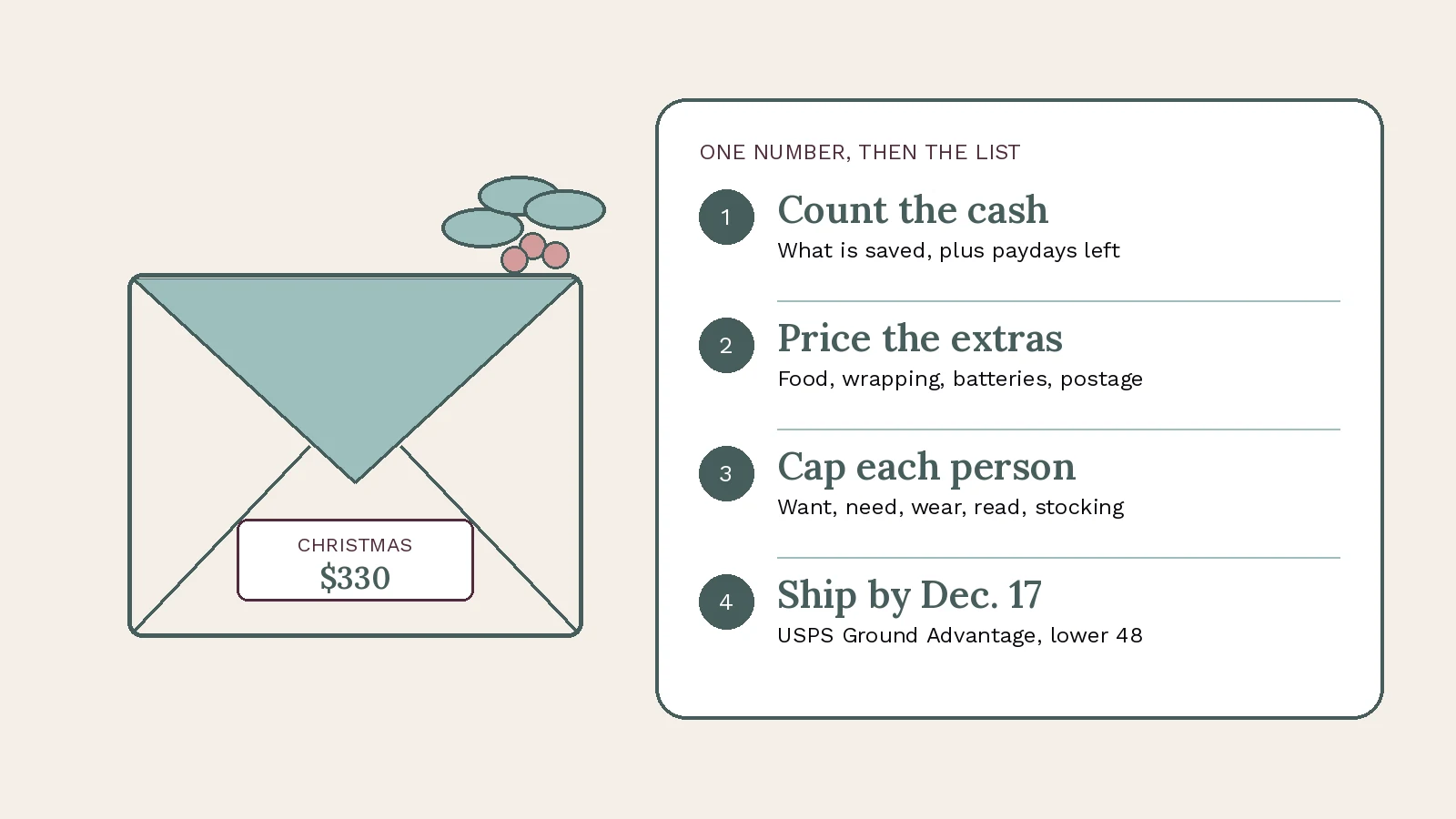
Most Christmas budget advice starts with a list of people and works out what it will cost. A big family on one income has to do it the other way around. Start with the money you will really have, take out everything that isn't a gift, and only then decide what each person gets.
That is what this plan does, one step at a time, at the kitchen table. There is a cap table you can copy and a printable checklist at the end.
Why the averages are the wrong target
You will see big numbers this month. Gallup's first 2026 holiday spending poll, taken October 1 to 19, found Americans expect to spend an average of $1,011 on Christmas or other holiday gifts. The same poll found 27% expect to spend less than $500, and 24% plan to spend less than last year, against 18% who plan to spend more.
The National Retail Federation's 2026 survey found 56% of holiday shoppers say the economy will affect their holiday spending. Among them, 43% plan to shop sales more often, 31% will comparison shop online more often and 29% will use coupons more often.
An average is a middle point across households of every size and income. It says nothing about what a family of seven on one paycheck can spend without carrying Christmas into March. The only number that matters is yours, and you find it by counting.
Count the money you will really have
Write down two things.
- What is already set aside for Christmas, in cash, an envelope or a savings account. Only money that isn't needed for a bill.
- What you can add each payday between now and your last shopping day, times the number of paydays left.
Pick your last shopping day from the shipping dates, not from Christmas Eve. The US Postal Service's recommended send-by date for USPS Ground Advantage and First-Class Mail to arrive before December 25 in the lower 48 states is Thursday, December 17. Priority Mail is Friday, December 18 and Priority Mail Express is Saturday, December 19. If you order online, check each store's own holiday shipping cutoff, which is often earlier than the USPS dates.
Here is a worked example with made-up numbers. A family has $180 set aside. They are paid every other Friday and can spare $75 a payday. Their paydays before December 17 are Friday, November 20 and Friday, December 4. That is $180 plus $150, so $330 is their whole Christmas. Not $400, not "about $350." $330.
Price everything that isn't a gift, first
This is where Christmas budgets quietly break. The gifts get planned and the rest gets bought at the checkout. List every non-gift cost with a price before you write down a single gift.
| Cost | Example family | Yours |
|---|---|---|
| Christmas dinner and baking, beyond a normal week | $60 | |
| Wrapping paper, tape and tags | $15 | |
| Batteries for gifts that need them | $12 | |
| Postage for gifts to family far away | $30 | |
| Gift exchange at co-op, school or work | $10 | |
| Total | $127 |
Take that total off the number you counted. Our example family has $330 minus $127, so $203 is the gift money. It is smaller than they hoped. It is also true, and true is what keeps January calm.
Set a cap for each person
Now divide. Start with an even split and adjust from there. This table shows the cap per person, rounded down to the whole dollar.
| Gift money | 6 people | 8 people | 10 people | 12 people |
|---|---|---|---|---|
| $150 | $25 | $18 | $15 | $12 |
| $250 | $41 | $31 | $25 | $20 |
| $400 | $66 | $50 | $40 | $33 |
| $600 | $100 | $75 | $60 | $50 |
Then shape it to your family. Our example family has five children and two grandparents on the list. The parents leave each other off this year. They give each child $35, which is $175. The grandparents get one handmade gift from all the children together, with $20 of materials. That is $195, leaving $8 as a cushion for the thing nobody remembered.
Write each person's cap next to their name and don't move money between people once shopping starts. If one child's gift comes in under the cap, the difference goes to the cushion, not to a bigger gift for someone else.
Give each child the same shape of Christmas
A simple way to keep gifts even across many children is a set shape. A common one is something they want, something they need, something to wear and something to read, plus a stocking.
It helps a big family in two ways. Every child opens the same number of gifts, so nobody counts boxes. And the need and wear gifts are often things you would buy in winter anyway, like boots, a coat or a new pair of jeans. That only saves money if you really would have bought them in December. If you wouldn't have, they belong inside the cap like everything else.
A shape also makes the cap easier to keep. Decide how the $35 splits before you shop, for example $12 want, $8 need, $8 wear, $3 read and $4 stocking. Used books and good secondhand clothes stretch a small cap a long way.
Shrink the list without shrinking Christmas
When the cap table comes out too small, the fix is usually fewer gifts, not cheaper ones.
- Draw names among the children, so each child gives one gift to one sibling instead of buying for all of them.
- Ask the extended family for a name draw too, with a set cap for everyone.
- Give one family gift instead of several small ones. The NRF found 27% of holiday shoppers plan to give an experience this year, up from 19% five years ago. A day pass, a family membership or a planned outing can be one line on the list instead of five.
- Make gifts by hand, and count what they cost. A handmade gift is only cheaper when the materials are priced. Our Handmade Christmas Gift Timeline plans the making week by week so it is done before the mail goes out.
Shop on a calendar, with cash
Nearly two thirds of consumers (64%) told the NRF they are likely to wait until Thanksgiving weekend to do most of their shopping. Sales are real, but a sale only helps if the item was already on the list under its cap. Bring the list. If something isn't on it, it waits until January.
Pay with money you have, in cash or by debit card. Buy now, pay later plans are everywhere this time of year, and the federal agencies that watch them point to the catches.
- The Federal Trade Commission says many of these plans charge high late fees, per-transaction fees or change fees, and some may report your payment history to the three nationwide credit bureaus, so a late or missed payment could hurt your credit.
- The Consumer Financial Protection Bureau says that if you return something bought this way, your loan agreement may require you to keep paying until the return or dispute is resolved, and that these loans don't offer the same dispute protections as credit cards if an item is faulty or a scam.
Splitting a $35 gift into four payments doesn't make it a $9 gift. It makes it a $35 gift you are still paying for in January.
If you ship to family far away, mail by the USPS dates above. USPS notes that Ground Advantage packages between the lower 48 and Alaska, Hawaii or the territories have a 10-day or longer service expectation, so Ground Advantage packages to those places need to go out earlier. Check the USPS estimate for your ZIP code before you mail. First-Class Mail, Priority Mail and Priority Mail Express have the same dates as the lower 48.
Tell the children the plan, in their size
A budget is easier to keep when nobody is surprised by it. Children don't need the dollar figures, but older ones can understand "one gift you want, one you need, one to wear and one to read," and that the family is buying what it has the money for. Knowing the shape also gives them a way to think about what to ask for.
Older children can also hold a small cap of their own for the sibling name draw, write it on a card and stick to it.
Do a five-minute review in January
The first week of January, write down what you really spent against each line, what you forgot, and what the children used most. Note sizes for next year. Then start next year's envelope with the first January payday. Even a small amount each payday gives next November a better number to start from.
Christmas budget plan
Count it
- Money already set aside, written down
- Amount I can add each payday
- Paydays left before Thursday, December 17
- Whole Christmas number, written and circled
Price the extras first
- Christmas dinner and baking
- Wrapping paper, tape and tags
- Batteries
- Postage
- Gift exchanges
- Gift money left after extras
Cap it
- Everyone on the list, with a cap beside each name
- Each child's gifts split into want, need, wear, read and stocking
- Name draws agreed with the children and the extended family
- A small cushion kept back
Buy it
- List brought on every shopping trip
- Paid with cash or debit, no buy now, pay later
- Ground Advantage and First-Class mailed by December 17
- Priority Mail by December 18, Priority Mail Express by December 19
January
- What we really spent, line by line
- Sizes and ideas for next year
- Next year's envelope started on the first payday
From mothersteader.com. Sources are listed with the full guide.
Keep the whole plan in one place
If you'd like all of this on paper, our Christmas Gift and Budget Planner for Big Families starts with the one big number and a payday savings plan, has a gift list for 30 people with a cap and a running total, a want, need, wear, read and make page for up to ten children, 12 stockings, handmade gift costs, the 2026 USPS send-by dates and a January review page. It is a fillable PDF you can type into or print.
When money is tight in other months too, our guide to a pantry that carries a family through a hard month works on the same idea. Plan from what you have, write it down and use it in order.
We send one email when a new guide or printable is ready. Sign up below if you'd like the next one.
Sources
- Holiday Shopping Plans Point to Average Retail Year (Gallup, 6 November 2026)
- Affordability Shapes Winter Holiday Shopping, According to NRF Holiday Survey (National Retail Federation, 20 October 2026)
- 2026 holiday shopping trends: What consumers are planning (National Retail Federation, 28 October 2026)
- 2026 Holiday Shipping Deadlines (United States Postal Service)
- Want to buy now but pay later? Read this first (Federal Trade Commission, 21 December 2022)
- Know before you buy (now, pay later) this holiday season (Consumer Financial Protection Bureau (archived blog post, undated))
From the shop
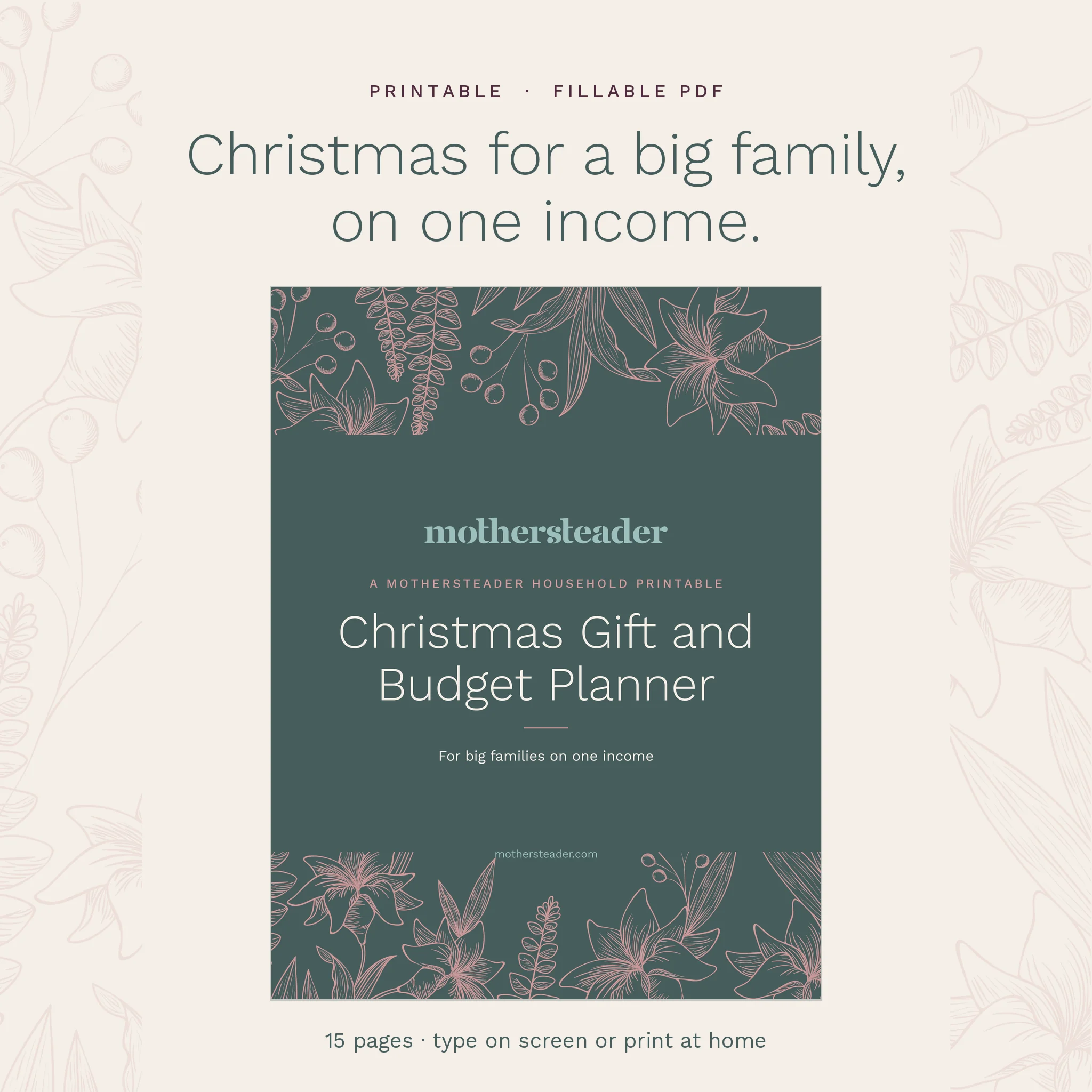
Christmas Gift and Budget Planner for Big Families
A Christmas gift and budget planner for a big family on one income. Room for 30 people, 10 children and 12 stockings, handmade gifts, the 2026 USPS send-by dates and a running total that tells the truth before December does. 15 fillable pages.
$5.50 $4.12
New guides and printables, now and then
One email when something new and useful is ready. No sales every week.